Showing posts with label lust research. Show all posts

Monday, October 13, 2008

Sex hormone


Sex steroids, also known as gonadal steroids, are steroid hormones that interact with vertebrate androgen or estrogen receptors. Their effects are mediated by slow genomic mechanisms through nuclear receptors as well as by fast nongenomic mechanisms through membrane-associated receptors and signaling cascades. The term sex hormone nearly always is synonymous with sex steroid.


Male sex hormone easily triggered

Surging testosterone?Scientists have proved that even the most seemingly innocent chat with a woman can be enough to send male sex hormones soaring.
A team from the University of Chicago paid students to come into their lab under the pretence of testing their saliva chemistry.
While there, the students got to chat to a young female research assistant.
Saliva tests showed the brief interaction was enough to raise testosterone levels by as much as 30%.
The more a man's hormone level shot up, the more attractive he later admitted to finding the research assistant.
And perhaps more tellingly, the research assistant herself was able to identify those men who found her attractive.
The men who she judged to be doing the most to try to impress her proved to be those who registered the biggest jump in testosterone levels.
However, little or no change was detected in the saliva of students who chatted with other men.
Animal reaction
Testosterone has long been closely linked with the male libido.
The researchers say their work is the first time that hard evidence has been produced in this way.
It is known that the release of testosterone in animals can embolden them, triggering courtship or aggressive behaviour.
The Chicago team believe the same may be true in humans.
However, lead researcher Dr James Roney said it was also possible that the release of the hormone was stimulated by a stress reaction.
Dr Roney told BBC News Online: "The findings are consistent with the existence of brain mechanisms that are specialised for the regulation of courtship behaviour and thus respond to cues from potential mates with coordinated behavioural and hormonal reactions.
"One might call these reactions components of a "mating response" which, if confirmed by future research, could be as basic and significant as, say, the well-known "fight or flight" reaction."
Dr Nick Neave, of the Human Cognitive Neuroscience Unit at Northumbria University, said the study was "very interesting".
"Other researchers have found changes in male hormone levels after watching erotic movies but this seems to be the first that has attempted to assess hormone changes when males meet women on a more 'normal' level."
Dr Benjamin Campbell, an expert in anthropology at Boston University, said it was possible that testosterone made men more bold by suppressing activity in an area of the brain called the amygdala, which controls the stress reaction.
Testosterone levels peak in a man by his early twenties, and then gradually diminish.
Men who are married or in long-term relationships have lower testosterone levels than those still playing the field.
The research is published in the journal Evolution and Human Behavior.


Estrogen and Testosterone Hormones


The differences between female hormones and male hormones may not be as specific as you might think. The definition of a hormone is a chemical substance produced by an endocrine gland that has a specific effect on the activities of other organs in the body. The major female and male hormones can be classified as estrogens or androgens. Both classes of male and female hormones are present in both males and females alike, but in vastly different amounts. Most men produce 6-8 mg of the male hormone testosterone (an androgen) per day, compared to most women who produce 0.5 mg daily. Female hormones, estrogens, are also present in both sexes, but in larger amounts for women.
Estrogens are the sex hormones produced primarily by a female's ovaries that stimulate the growth of a girl's sex organs, as well as her breasts and pubic hair, known as secondary sex characteristics. Estrogens also regulate the functioning of the menstrual cycle.
In the majority of women, ovarian hormones appear not to play a significant role in their sex drive. In one study of women under the age of 40, 90 percent reported experiencing no change in sexual desire or functioning after sex hormone production was shut down because of the removal of both ovaries.
The Importance of EstrogenEstrogens are important in maintaining the condition of the vaginal lining and its elasticity, and in producing vaginal lubrication. They also help preserve the texture and function of a woman's breasts.
In men, estrogens have no known function. An unusually high level, however, may reduce sexual appetite, cause erectile difficulties, produce some breast enlargement, and result in the loss of body hair in some men.
Androgens are sex hormones produced primarily by a male's testes, but are also produced in small amounts by the female's ovaries and the adrenal gland, an organ found in both sexes. Androgens help trigger the development of the testes and penis in the male fetus. They jump start the process of puberty and influence the development of facial, body and pubic hair, deepening of the voice, and muscle development, the male secondary sex characteristics.
After puberty, androgens, specifically testosterone, play a role in the regulation of the sex drive. Large deficiencies of testosterone may cause a drop in sexual desire, and excessive testosterone may heighten sexual interest in both sexes. However, testosterone levels are poorly correlated with sexual interest and drive when they are within the average range. Sex drive is much more likely to be affected by external stimuli (sights, sound, touch) than by variations in sex hormones, except in extreme cases.
Too Little Testosterone in MenIn men, too little testosterone may cause difficulty obtaining or maintaining erections, but it is not clear whether testosterone deficiencies interfere with female sexual functioning apart from reducing desire.
However, there is no evidence whatsoever to suggest that because women have less testosterone than men do, they have lower sexual interest than their male counterparts. Instead, it seems that women detect and react to much smaller amounts of testosterone in their circulation than men do.


Aging, illness and certain cancer treatments can affect our bodies' delicate hormonal balance, causing changes in sexual interest and functioning. Familiar to most are the changes that occur when a woman goes through menopause. Estrogen production drops throughout this process as a woman exits her child-bearing years.
The major sexual impact of decreased estrogen is a shrinking of the vagina and thinning of the vaginal walls, along with a loss of elasticity and decreased vaginal lubrication during sexual arousal. Some women experience only slight changes in sexual functioning, while others have dryness and pain with intercourse, or genital soreness for a few days after sexual activity, if they don't use a vaginal lubricant or take some form of hormone replacement.
Researchers investigating the effects of hormone replacement therapy on women's sexual functioning have shown that taking estrogen often allows sexual functioning to return to normal. In addition, androgens have been prescribed for postmenopausal women to enhance their sexual desire.
Hormone-Replacement TherapyPerhaps less well known is the fact that men sometimes experience lowered testosterone levels, which can be responsible for sexual dysfunction. How this hormonal decrease affects the man's sex drive and erections remains unclear. But urologists, as a treatment for these difficulties, sometimes recommend testosterone replacement. There is a great deal yet to be learned about which men and women may require and benefit from hormone-replacement therapy.
It is tempting to try to understand sexual behavior solely in terms of hormones. In many animal species hormones that control the female's willingness to mate and the courtship and sexual behavior of the male tightly regulate patterns of sexual behavior.
In humans, however, there is a more complicated relationship between hormones and sexual behavior. Although a substantial testosterone deficiency usually reduces sexual interest in men and women, there are cases in which that effect is not seen.
Similarly, although many men with below normal testosterone levels have difficulty with erections, not all do. Women who have low amounts of estrogen in their bodies do not lose their ability to be sexually aroused or to have orgasms.
In short, sex hormones are not the only factors affecting sexual interest or behavior. If you are concerned about your hormone levels and whether they may be effecting your general health or your sexual functioning, consult your doctor for some easily performed and (almost) painless laboratory blood work.

Sunday, January 13, 2008

A research from Oxford University :Electrons’ ‘love-hate’ clue to superconductivity


A form of ‘shimmering’ superconductivity may offer vital clues as to how superconductors work, according to Oxford University scientists.

The ‘shimmering’ occurs when electrons are caught in two minds about whether they ‘love’ each other (pairing up to create superconductivity) or ‘hate’ each other (are repelled, creating insulating behaviour). In this week’s Nature the Oxford team report that, in a molecular superconductor on the borderline between superconducting and insulating behaviour, a slight preference for love over hate can result in a fluctuating state of superconductivity that exists at temperatures 50% higher than that at which ordinary superconductivity is destroyed.

Superconductors are materials that, once cooled to their critical temperature, exhibit zero electrical resistance and resist the penetration of magnetic fields: They are already finding applications in MRI scanners and electrical power technology.

While shimmering superconductivity only occurs at extremely low temperatures (18K-12K) scientists think that understanding it could lead to future breakthroughs in room-temperature superconductors. The Oxford experiment provides hard evidence that the effect exists in bulk superconductors and is not the result of impurities in the materials being studied.

The discovery was made by Dr Moon-Sun Nam working with Dr Arzhang Ardavan and Professor Stephen Blundell of Oxford University’s Department of Physics, using samples prepared by Dr John Schlueter at Argonne National Laboratory. The team used a probe that can detect when superconducting vortices are present even when a material does not exhibit zero electrical resistance – the conventional measure of ordinary superconductivity.

‘This observation sheds new light on the mechanisms of exotic superconductivity, which have remained elusive despite a number of experimental breakthroughs,’ said Dr Ardavan. ‘We believe that the fluctuating effect should be found in many superconductors in which the ‘love-hate’ relationship between electrons is finely balanced. It represents an important step forward in the quest to understand exotic superconductors.’

Saturday, January 12, 2008

I love you ?How to tell love from lust

sponsored by 24hoursnews
I love you.
Means what ?
Love appears to be a more evolved behaviour than lust, according to new research that has mapped the brain's centres of love, lust and attachment.

The authors of the study believe that lust is quite different from love.

"[Love] requires more sophisticated behaviours, reward and memory systems than other mammals," says lead author Dr Lucy Brown, a neurologist at the Albert Einstein College of Medicine in New York.

"It is present to some degree in other primates that are close to us in brain development."

She says humans have evolved three distinct brain systems for mating and reproduction: the sex drive, romantic love and attachment to a long-term partner.

Brown and her colleagues took magnetic resonance images, or pictures of brain activity, of 17 young men and women who described themselves as being "newly and madly in love."

The researchers compared the MRI data with earlier studies on male penile girth responses to photographs of women, other studies on how the brains of men and women activate when individuals view people they find to be attractive or unattractive, and data on both human and animal couples that have been together for a long time.

The findings will be published in the July issue of the Journal of Neurophysiology.

Left versus right brain

The researchers discovered that early stage romantic love feelings are located mainly on the right side at the base of the brain, or the ventral midbrain, and in the middle of the brain, the caudate nucleus.

Long-term attachment, on the other hand, appears to be centred in the front and base of the brain, or the ventral putamen and the pallidum.

Feelings related to lust and sexual arousal occupy different areas, mostly located on the left-hand side of the brain.

The area of overlap seems to mostly involve visual information, but for romantic love to set in, it takes more than just a lustful pang and a pretty face.

Lust is good but love is better

Lust obviously can lead to procreation, which ensures the survival of a species, but the scientists believe love is better for humans in the long-term.

"Simple lust may be necessary in extremely difficult survival circumstances when there is no time for romance," Brown says.

"It is known that people in very dangerous and threatening situations can suddenly find themselves lusty for each other, even though they are strangers.

However, under safe circumstances within a stable society, romantic love and attachment may be the best and more efficient way to continue species survival."

Brown and her team believe that "love at first sight" is a real phenomenon, but they say other non-visual aspects of a person, such as mannerisms, voice, personality and social status, usually must come into play if lust is to evolve into love.

The researchers suggest "love at first sight" and the obsessive goal-driven aspects of early love are both evolved behaviours that speed up mating and provide a better chance for successful reproduction.

"Rather than get up the energy to go to a different bar every night and maybe be successful in finding a different person every night, sticking to the same person, being able to have sex without spending time on the search may increase chances for pregnancy," Brown says.

Crazy for you?

Dr Donatella Marazziti, a University of Pisa scientist who has also studied the brain and biochemical activity of people in love, agrees with the findings.

Marazziti says she isn't not surprised by the neural basis for "love at first sight," since, according to her theory, "love is a basic emotion, which would use the system of the basic emotions and, as such, it is sudden and unpredictable."

Marazziti also says that romantic lovers are a bit "crazy," since they can experience chemical imbalances within the brain.

Mental health experts have linked somewhat similar imbalances to depression, anxiety and obsessive-compulsive disorders.

Sunday, December 30, 2007

Lust Facts :Always aroused: A good thing gone awry


we should all be careful what we wish for when we are wishing for more feelings of desire. “Anything unrelenting is torture.”
Suze has begun conversations with doctors this way: "I want to talk to you about something, but you have to give me your word you will not laugh or give a flippant response because it is a serious situation."
In short, Suze has too much of a good thing. For days, sometimes weeks at a time, she feels constantly aroused, but can't get any satisfaction.
Despite the preamble, though, "one doctor looked at me and said, 'What a lucky man your husband is! I wish my wife had this,'" says Suze, 63, a retired nurse in Florida. Others have asked, "So, is this like being a nymphomaniac?"
Hardly. Suze, who asked that her last name not be published, has what is now called persistent genital arousal disorder, or PGAD. It was first named by sex therapist Sandra Leiblum in 2001 as persistent sexual arousal syndrome, but as Leiblum and others have begun studying patients, she decided that it was more a disorder than a syndrome, a syndrome being a constellation of symptoms that suggest the presence of true disease.
In a recent article in the Journal of Sexual Medicine, Leiblum and her co-authors identified a series of medical and psychological traits, including depression and panic attacks, that can accompany PGAD. Though some women are helped by psychiatric drugs, Leiblum strenuously resists the idea that the problem is necessarily psychological. “I do think there is always some organic contribution, but we just do not know what it is.”
Exactly what it is remains murky, but Suze’s symptoms, like that of other sufferers, involves a feeling of "fullness" — a constant engorgement — of the genitals that is unprompted by erotic thoughts or feelings.
"I could be in the middle of a tennis game [or] playing canasta," Suze says, "and then suddenly have this intense urge for intimacy. I could masturbate five times or 105 times and it would only make it worse."
Leiblum, who is now in private practice in Bridgewater, N.J., and treats a wide variety of sexual and relationship complaints, says her description of the disorder did not occur until 2001 because, like most sex therapists (and sex columnists), she heard many more complaints about lack of desire and arousal than she ever heard about too much of it.
Some women with PGAD tried approaching doctors, Leiblum says, but “I took it seriously and listened to what women were telling me. I said to myself, ‘This is bizarre and different from anything else I have heard of,’ but I believed what women told me rather than writing them off.”
Nobody knows how many women might suffer from PGAD. And the feeling of genital arousal is not always unwelcome. Some women like it. But if it is not causing distress, it is not considered a disorder, and so such women cannot be said to truly have PGAD. The ones who do describe a living hell.
Just repressed?
Heather Dearmon, a 33-year-old housewife and mother in South Carolina, became so desperate she voluntarily had herself committed — twice — to psychiatric institutions. “One psychiatrist said I must be sexually repressed and needed to experiment more," she says. "He suggested I try lesbianism.”
Her symptoms began during her pregnancy with her son. She asked her ob-gyn, who suggested that the pregnancy may have played havoc with Dearmon’s hormones and advised waiting it out, hoping the urges would subside after the birth. “But the day after I gave birth they came back,” she recalls.
The feelings were so intense and so persistent that she was unable to ignore them or even carry out daily functions. “It got to the point where morning, afternoon and night I had to take care of it. But the more you masturbate, the more you desensitize yourself so it would take a good hour to have three orgasms. This is at the point when I started to become suicidal. My whole life was being robbed from me.” She began pushing her husband away because she treasured any time she was not feeling aroused.
Finally, with her fears mounting over plans for a long family car trip, a doctor prescribed the anti-anxiety medication Paxil. Soon after beginning dosing herself, she found the urges became less frequent. Now, she can go up to 10 days without having to masturbate, though by day seven the arousal, focused on her clitoris, is often severe.
Why this happens remains a mystery. Research is still at an early stage, but some tantalizing hints have begun to emerge. One of Leiblum’s collaborators in England has found that some women complaining of PGAD can have concomitant conditions like a yeast infection or a dermatological outbreak around the genitals. But Leiblum stresses that the only thing for sure is that both can happen at the same time, not that one causes the other.
Sometimes biofeedback techniques can help, suggests sex researcher Beverly Whipple. “A couple of women were very successful,” she says.
Sex and the brain
Whipple, Leiblum and Rutgers University psychology professor Barry Komisaruk (Whipple’s co-author of their 2006 book, "The Science of Orgasm") are currently using MRIs to examine the brains of women suffering from PGAD in hopes of discovering how the central nervous system might play a role.
The PGAD mystery is just one of several linking the brain with too much arousal. One woman had spontaneous orgasms while brushing her teeth though she did not have orgasms while having intercourse or masturbating. The tooth brushing apparently triggered epileptic seizures that, in turn, caused the orgasms. (People with epilepsy sometimes do experience what is called “orgasmic aura.” In some cases, patients have been known to refuse treatment because they like the sensations.) Another woman had orgasms due to a vascular abnormality in her brain.
Men with obsessive-compulsive disorder have been known to have unwanted and unexpected erections. Parkinson’s patients can become hypersexual. So can people with brain injuries.

Men with a condition called priapism also can have too much of a good thing. Those constant reminders at the end of commercials for impotence drugs tell men that if they have an erection lasting four hours or longer they should seek medical advice. What they don’t say is that you might have priapism, an erection that simply won’t go away. Unlike PGAD, priapism does not usually result in a man craving release, it’s just very painful, a hydraulic malfunction that can be treated by — have a seat men — sticking a needle into the penis to draw blood out.
But even that gruesome scenario is nothing compared to what some of the women suffering from PGAD say they have experienced.

Tuesday, December 25, 2007

Future of Love and Sex - Robots soon will become more human-like in appearance, researcher says


The New York Times has a review of British AI researcher David Levy's book 'Love and Sex with Robots'. He claims that within a span of about 50 years the day will come when people could actually fall in love with life-like robots. While this may seem far fetched at first, he has some pretty interesting views. 'He begins with what scientists know about why humans fall in love with other humans. There are 10 factors, he writes, including mystery, reciprocal liking, and readiness to enter a relationship. Why can't these factors apply to robots, too?' The case he builds goes much further though, and certainly provides food for thought."
Sex and marriage with robots? It could happen
Humans could marry robots within the century. And consummate those vows.

"My forecast is that around 2050, the state of Massachusetts will be the first jurisdiction to legalize marriages with robots," artificial intelligence researcher David Levy at the University of Maastricht in the Netherlands told LiveScience. Levy recently completed his Ph.D. work on the subject of human-robot relationships, covering many of the privileges and practices that generally come with marriage as well as outside of it.

At first, sex with robots might be considered geeky, "but once you have a story like 'I had sex with a robot, and it was great!' appear someplace like Cosmo magazine, I'd expect many people to jump on the bandwagon," Levy said.

The idea of romance between humanity and our artistic and/or mechanical creations dates back to ancient times, with the Greek myth of the sculptor Pygmalion falling in love with the ivory statue he made named Galatea, to which the goddess Venus eventually granted life.

This notion persists in modern times. Not only has science fiction explored this idea, but 40 years ago, scientists noticed that students at times became unusually attracted to ELIZA, a computer program designed to ask questions and mimic a psychotherapist.

"There's a trend of robots becoming more human-like in appearance and coming more in contact with humans," Levy said. "At first robots were used impersonally, in factories where they helped build automobiles, for instance. Then they were used in offices to deliver mail, or to show visitors around museums, or in homes as vacuum cleaners, such as with the Roomba. Now you have robot toys, like Sony's Aibo robot dog, or Tickle Me Elmos, or digital pets like Tamagotchis."

In his thesis, "Intimate Relationships with Artificial Partners," Levy conjectures that robots will become so human-like in appearance, function and personality that many people will fall in love with them, have sex with them and even marry them.

"It may sound a little weird, but it isn't," Levy said. "Love and sex with robots are inevitable."

Sex with robots in 5 years
Levy argues that psychologists have identified roughly a dozen basic reasons why people fall in love, "and almost all of them could apply to human-robot relationships. For instance, one thing that prompts people to fall in love are similarities in personality and knowledge, and all of this is programmable. Another reason people are more likely to fall in love is if they know the other person likes them, and that's programmable too."

In 2006, Henrik Christensen, founder of the European Robotics Research Network, predicted that people will be having sex with robots within five years, and Levy thinks that's quite likely. There are companies that already sell realistic sex dolls, "and it's just a matter of adding some electronics to them to add some vibration," he said, or endowing the robots with a few audio responses. "That's fairly primitive in terms of robotics, but the technology is already there."

As software becomes more advanced and the relationship between humans and robots becomes more personal, marriage could result. "One hundred years ago, interracial marriage and same-sex marriages were illegal in the United States. Interracial marriage has been legal now for 50 years, and same-sex marriage is legal in some parts of the states," Levy said. "There has been this trend in marriage where each partner gets to make their own choice of who they want to be with."

"The question is not if this will happen, but when," Levy said. "I am convinced the answer is much earlier than you think."

When and where it'll happen
Levy predicts Massachusetts will be the first jurisdiction to legalize human-robot marriage. "Massachusetts is more liberal than most other jurisdictions in the United States and has been at the forefront of same-sex marriage," Levy said. "There's also a lot of high-tech research there at places like MIT."

Although roboticist Ronald Arkin at the Georgia Institute of Technology in Atlanta does not think human-robot marriages will be legal anywhere by 2050, "anything's possible. And just because it's not legal doesn't mean people won't try it," he told LiveScience.

"Humans are very unusual creatures," Arkin said. "If you ask me if every human will want to marry a robot, my answer is probably not. But will there be a subset of people? There are people ready right now to marry sex toys."

The main benefit of human-robot marriage could be to make people who otherwise could not get married happier, "people who find it hard to form relationships, because they are extremely shy, or have psychological problems, or are just plain ugly or have unpleasant personalities," Levy said. "Of course, such people who completely give up the idea of forming relationships with other people are going to be few and far between, but they will be out there."

Ethical questions
The possibility of sex with robots could prove a mixed bag for humanity. For instance, robot sex could provide an outlet for criminal sexual urges. "If you have pedophiles and you let them use a robotic child, will that reduce the incidence of them abusing real children, or will it increase it?" Arkin asked. "I don't think anyone has the answers for that yet — that's where future research needs to be done."

Keeping a robot for sex could reduce human prostitution and the problems that come with it. However, "in a marriage or other relationship, one partner could be jealous or consider it infidelity if the other used a robot," Levy said. "But who knows, maybe some other relationships could welcome a robot. Instead of a woman saying, 'Darling, not tonight, I have a headache,' you could get 'Darling, I have a headache, why not use your robot?' "

Wednesday, November 21, 2007

Hiten talks about love & lust


Hiten Tejwani reveals all.


Your first crush...

I really can’t remember.

Your first date...

That was when I was in college. I was in Jai Hind. She was in the same college. We went to the nearby Satkar restaurant.

Your idea of a perfect date...

With my wife Gauri on a beautiful island. We both loves beaches. So, it would be just perfect for us.

What qualities do you look for in a woman?

It’s not about external appearance, but inner beauty. Somebody who is a nice person and understanding. If she has a good sense of humour that would be the icing on the cake.

What was your first relationship like?

I was in my teens then. It was when I was in college. Actually it was a learning experience.

What do you think about lust versus love?

Where there is love there is lust.

What is romance to you?

It’s about being there for each other always.

Who’d you like to get dirty with on an island?

So many of them!!

Do you believe in the institution of marriage?

Yes of course. Marriage is a serious matter. Whoever plans to get married must remember they are getting into a bond which is forever. Two people in a marriage have to make it work. They are two different individuals who’ve come together and there are bound to be some differences. It’s all about adjusting and having a good understanding.

Your take on infidelity?

Why cheat on your partner and put your marriage in trouble. It makes no sense.

Friday, November 2, 2007

Lust, not love, the driving factor behind sex


RESEARCHERS in the US have found that the motivation for having sex is largely the same for men and women, seemingly shattering the myth that the genders have different reasons for racing to the bedroom.


The researchers compiled a list of 237 reasons given by US college students for getting frisky - and the top reasons for men and women were more to do with lust than a deep love connection.


Blogs What are your top reasons? Is it all over after uni?
Tell us using the form below »


The findings would apparently contradict the assumption by some that it is only men who are motivated by lust, whereas women only want sex as an expression of a deep emotional feeling.


Seven of the top 10 reasons for men revolve around the pleasure of the act. The top response was "I was attracted to the person", while "It feels good", "It's fun" and "I wanted to experience pleasure" were also in the top four.


For women, the top response was the same: "I was attracted to the person". Six of the remaining nine answers in the top 10 were also centred on the women feeling pleasure from the act.


Three of the top 10 reasons for men and women involved providing pleasure to the partner. For women, those reasons rated slightly higher on the leaderboard.


The study was compiled - and paid for - by researchers at the University of Texas over five years and published in the August edition of the journal Archives of Sexual Behaviour.


"It's refuted a lot of gender stereotypes ... that men only want sex for the physical pleasure and women want love," University of Texas clinical psychology professor Cindy Meston, the study's co-author, told the Associated Press.


"That's not what I came up with in my findings. None of the gender differences are all that great.


"Men were more likely to be opportunistic towards having sex, so if sex were there and available they would jump on it, somewhat more so than women. Women were more likely to have sex because they felt they needed to please their partner."


Another expert who was not involved in the study said its findings backed up other research suggesting the often-assumed sexual differences between men and women were only factors for those with sexual problems.


Prof Meston did concede, however, that the study's focus on university students - whose "hormones run rampant" - might have affected the findings.


She said more differences may emerge as people grow older.


The bottom five reasons given by men and women were surprisingly vindictive, ranging from "I wanted to punish myself" or "I wanted to end my relationship" to "I wanted to give someone else a sexually transmitted disease".


Benefits also figured in the bottom rungs of the list. "I wanted to get a job" was fifth from bottom for men, while "The person offered to give me drugs for doing it" was the very lowest ranked.


"I wanted to get a job" and "I wanted a raise" were among the bottom reasons given by women.


Technorati : ,

Thursday, October 25, 2007

Lust for sex is depand on Size of brain


Lust for sex is a common factor


Australian scientists have found out what part of the brain is responsible for sexual attraction between people. They also found out that the bigger that part of the brain is, the faster and more intense man's excitement is.
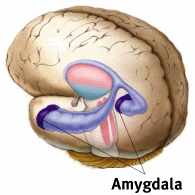
The researchers, a group of neurophysiologists from the University of Melbourne, say that the degree of excitement depends upon the activity of the part of the brain called 'amygdala'. This part of the brain has the size of an almond. When you feel sexual irritants, the amygdala will respond faster than any other part of the brain.


Before the researchers discoverd this, it was already believed that the amygdala was responsible for attraction between animals.


After examining 45 epilictics of whom part of the brain is not working, amygdala included, it turned out that the amygdala plays a large role in the sexual experience. The bigger the amygdala, the bigger the sexual lust. People with large parts of the amygdala not functioning were almost indifferent to sex.


Technorati :

Monday, October 22, 2007

SEPARATING LUST AND LOVE # 1


. LUST—RESPONDING TO IMPRINTED SEXUAL FANTASIES

A. Where Does Lust Come From?

Lust is the sexual feeling we find arising within ourselves
when we meet a person who triggers our sexual responses.
Our sexual responses were imprinted into us at an early age
—probably before age 20 and perhaps most importantly during adolescence.

We might like to think that our sexual responses came from our animal ancestors,
but that would not explain why we are aroused by
words, stories, myths, settings, clothing, etc.
We get 'turned on' by all kinds of things that have strong symbolic content,
which is not possible for the other animals,
since they do not use abstract symbols.

But it seems safe to assume that human lusting
has been happening for at least 100,000 years,
which marks the beginning of our symbolic capacity
and the emergence of human language.
These early humans probably had different sexual imprinting,
but they were probably 'turned on' by sexy stories just as we are.

Which people really 'turn us on'
—even if we do not know them personally?
What are our best lust-objects?
Heterosexual males find themselves sexually attracted
to conventionally-sexy females.
Heterosexual females find themselves sexually attracted
to conventionally-sexy males.
Just switch the lust-objects for most homosexual males and females.

We grow up knowing that we lust after certain kinds of people.


--------------------------------------------------------------------------------

B. Does Our Lust-Response Change and Mature Over a Life-Time?

When we were teen-agers we lusted after others our own age.
And it now appears that those we lusted for in our youth
remain inside our sexual brains for the rest of our lives.
Thus as our bodies and minds get older and more mature,
our sexual responses do not mature along with us.
We still find ourselves 'turned on' by the images that aroused us in our teen years.

We might find ourselves torn between
the mature adults we have become in every other way
and the 'adolescent' sexual responses that still control our sexual brains.


--------------------------------------------------------------------------------

C. How Should We Respond to the Lust We Find within Ourselves?

Even tho we discover that we cannot change the lusty stories in our brains,
we are always responsible for the sexual behavior we create from those impulses.
Some of us experience no conflict between our sexual imprinting
and the behavior that naturally follows from it.
We might actually enjoy the resulting sexual behavior.

But if as we become more mature adults,
we do not like the specific sexual response we find within ourselves,
then we have the difficult task of re-creating our sexuality
so that it reflects more the persons we have become in adulthood
than the teen-agers we were some years ago.


--------------------------------------------------------------------------------

II. ROMANTIC LOVE—HOW OUR HEARTS WERE TRAINED TO 'FALL IN LOVE'.

One of the most common alternatives to lusting is loving.
But the kind of love we usually mean is romantic love,
which also might lead us into problems.

A. Where Does Romantic Love Come From?

Just as we might like to believe that our human sexuality is 'natural',
so we usually assume that 'falling in love' comes naturally.
But historical investigation has discovered
that what we know as romantic love is only about 800 years old.
This seems shocking and impossible to us as first,
since we know that people have been mating and reproducing for millions of years.
But if we clearly separate lust from love,
we can see that lust might have accounted for the sexual behavior of our ancestors
even if they could never have understood a romantic Hollywood movie.

Romantic love is a cultural construct,
which has been spread over the whole Earth by the mass media.
Before radio, television, and movies—100 years ago—
large parts of the world had never heard of 'falling in love'.
They still had sexual relationships and families, of course,
but the fantasy of romantic love did not run their relationships.

Romantic love is basically an emotional story we tell ourselves.
By means of the mass media, we have been programmed
so that we 'fall in love' following the patterns prescribed in the Hollywood script.
We try to reproduce a fantasy feeling.
We 'fall in love' with the Dream Lover we brought with us
when we set out to find "someone to love".


--------------------------------------------------------------------------------

B. Does Our Romantic Response Change and Mature Over a Life-Time?

Because we have learned how to 'fall in love' from the surrounding culture,
it is also possible to unlearn this emotional programming.
However, if we are enjoying the game of romance,
we might not want to be awakened from that dream.
Only when the romantic delusion starts to fall apart
do we begin to look for more mature ways of loving.

So, at least for some people, romantic love can be replaced by relationships
not based on emotional responses learned from the culture
but based on the two persons as they are re-inventing themselves to be.
Meaningful loving relationships can be created
completely beyond the romantic mythology.


--------------------------------------------------------------------------------

C. How Should We Respond to the Romantic Feelings We Find within Ourselves?

Many of us have few problems with the romantic responses we experience.
We enjoy the game of falling in and out of love.
And we will continue to seek new romantic adventures for the rest of our lives.

We might decide that the game of romance is harmless,
as long as all players realize
that they are trying to re-create a story they saw on television.

But after a few more cycles on the merry-go-round of love,
we might ask whether we want to repeat this fantasy-script.

A more mature response can leave the romantic fantasies behind
and proceed to create relationships beyond romantic illusions.


--------------------------------------------------------------------------------

III. BEYOND BOTH LUST AND LOVE—CREATING UNIQUE RELATIONSHIPS.


A. Where Do Relationships Come From?

As strange as it might seem to some people at first,
it is possible to create relationships beyond our imprinted sex-scripts (the lust response)
and beyond our emotionally-programmed romantic feelings (the love response).
These relationships will be based in something much more substantial
—in the new persons we are creating ourselves to be.

In other words, loving relationships based in Authenticity
emerge from the actual interaction of two people who are building that relationship.
Piece by piece, we can create new patterns of being together
that have never been attempted before.
We are not prisoners of our imprinted sex-scripts.
We do not need to replicate romantic feelings we leaned from the movies.

What we choose as our central purposes in life
can also become central to our loving relationships.
In freedom we can re-create our selves—and our relationships.


--------------------------------------------------------------------------------

B. Do Our Loving Relationships Change and Mature Over a Life-Time?

When our loving relationships are based on our own free choices
rather than our imprinted sexual fantasies
or the romantic traditions we picked up from society,
then we are also free to change our relationships as the years go by.
In fact, it is very likely that we will create new dimensions of our relationships
while we let some older aspects die away as no longer meaningful.
If we become more Authentic in new ways,
those changes will also show themselves in our relationships.
Our sexual responses will probably remain the same.
And the romantic tradition will continue into the foreseeable future.
But as free persons, we can create new kinds of relationships.


--------------------------------------------------------------------------------

C. How Do We Conduct and Transform Our Loving Relationships?

When we were still allowing our connections with others
to be shaped by our sexual responses and our romantic dreams,
we had to fight against these influences
if we wanted to do anything that was definitely our own.
But once we begin to re-invent love for the two persons we are and are becoming,
then the next phase of our relationship will be whatever we decide it will be.

We conduct our relationship by making daily decisions
about what we will do together.
And we make major transformations of our relationship
by discussing and deciding what new things we will try.
With each new experiment in our relationship,
we will evaluate the results as seen from both sides.
We will abandon the changes that did not work for us.
And we will continue and develop the new dimensions that we both like.

Lusting and 'falling in love' are only the beginning.
After we get beyond sex and romance,
we can use our creativity to re-invent love.

SEPARATING LUST AND LOVE


Connecting with other persons is an important dimensions of living.

One of the first things that draws us to other people is our sexual response.
But because lust responds to abstract characteristics of the other,
we might find simple sex a deficient basis for an on-going relationship.

Parallel to our sexual responses we also find ourselves 'falling in love'.
This emotional response has deep roots in our Western culture.
But romantic love is also a deficient basis for a meaningful relationship.

Beyond lust and love, it is still possible to create relationships
based on the persons we are inventing ourselves to be.
Beyond sexual and emotional givens,
we can love freely and creatively.

OUTLINE:
I. LUST—RESPONDING TO IMPRINTED SEXUAL FANTASIES.

A. Where Does Lust Come From?

B. Does Our Lust-Response Change and Mature Over a Life-Time?

C. How Should We Respond to the Lust We Find within Ourselves?

II. ROMANTIC LOVE—HOW OUR HEARTS WERE TRAINED TO 'FALL IN LOVE'.

A. Where Does Romantic Love Come From?

B. Does Our Romantic Response Change and Mature Over a Life-Time?

C. How Should We Respond to the Romantic Feelings We Find within Ourselves?

III. BEYOND BOTH LUST AND LOVE—CREATING UNIQUE RELATIONSHIPS.

A. Where Do Relationships Come From?

B. Do Our Loving Relationships Change and Mature Over a Life-Time?

C. How Do We Conduct and Transform Our Loving Relationships?

SEPARATING LUST AND LOVE

Lust thinks


Lust is a primary ingredient of sex addiction. In our correspondence with sex addicts, we find that people are often confused about what lust is. Lust is harmful to the body, mind and spirit, and it can easily be mistaken for love. Lust has the opposite effect of love.

Definitions (Webster’s 9th New Collegiate Dictionary):
Lust: (n) Intense or unbridled sexual desire, lasciviousness...an intense longing: craving; (v) to have an intense desire or need, crave
Desire: (n) Conscious impulse toward something that promises enjoyment or satisfaction in its attainment... longing, craving...Sexual urge or appetite

How lust got started: One of the Greek words for lust is Epithumia (Strong’s #1939), meaning the "desire for what is forbidden." It is based on the lie that the forbidden pleasures are worth the cost (see sex addiction lies). Satan used this lie in the Garden and Eden. He suggested that eating the forbidden fruit would bring great god-like wisdom and the punishment wouldn't be that bad. This strongly appealed to Eve (Pride of Life), who also liked the fruit's appearance (lust of the eyes), and wanted to eat it (lust of the flesh). She discovered that the fruit did not deliver what she thought it would. The consequences included curses and separation from God.

What God says about lust: Lust is sin (Matthew 5:28) and sin is death (Romans 6:23). Jesus said, "But I say to you that whoever looks at a woman to lust for her has already committed adultery with her in his heart" (Matthew 5:28 NKJV). When we entertain fantasies through pornography, masturbation, voyeurism, adultery, fornication, phone sex, etc., we sin with our minds. According to Jesus, that's the same as committing the act.

Lust and pornography: Pornography uses the same lies that Satan used in the Garden of Eden. Porn images tempt our eyes and flesh to lust (see how porn works page). James described the temptation process in James 1:14-15 NKJV: "But each one is tempted when he is drawn away by his own desires and enticed. Then, when desire has conceived, it gives birth to sin; and sin, when it is full-grown, brings forth death." Sin by lust causes the death of innocence, sexual health, the ability to love and sensitivity to God.

What lust does to us: Lust has many destructive effects. The most serious effect is that lust corrupts our ability to love God. John explained that lust is a way of loving the world. He wrote, "Do not love the world or the things in the world. If anyone loves the world, the love of the Father is not in him. For all that is in the world--the lust of the flesh, the lust of the eyes, and the pride of life--is not of the Father but is of the world. And the world is passing away, and the lust of it; but he who does the will of God abides forever" (1 John 2:15-17 NKJV). Lust cripples our ability to give and receive love, and blocks God's love from working in us. See our page Lust vs. Love for more information.

Other effects of lust include slavery to sin, dissatisfaction, blocked blessings, separation from God, ruin, self-hatred and hardening of our heart. For an in-depth look at these, see our What Lust Does page.

Prayers: Removing lust from your life begins with confessing and repenting from our lust. We can pray this simple prayer to confess our sin to God:

"Lord, I confess that I have lusted in these specific ways: ……(name them all). I see my attitudes as sinful. I am sorry for grieving your heart in my pursuit of carnal pleasure with my eyes and mind. I ask Your forgiveness through the blood of Jesus Christ. Thank you, Lord, for this forgiveness I have in Jesus Christ."

Repenting from our sin is just as important as confessing it (Luke 13:3). Repentance means to turn from our sin and commit to living for God. We must sincerely turn from our sin and avoid it from this point forward:

"Lord Jesus, I turn from my lustful ways now, and I surrender every source I have used for lust: ....(name them all). I cast them off from my mind and body, committing my eyes, mind and body to serving you in holiness with your help. Lord, please teach me, strengthen me, guide me, and draw me close to You for the difficult road ahead. Thank You, Jesus, Amen."

Friday, October 19, 2007

"My Lust For Sex"


by an Anonymous Female, age 43


"I was so glad to find a story at this site about another Christian female that was addicted to sex. However, she was 19 and I am in my forties."
Sex became an addiction to me when I was only a teenager. I became promiscuous at a very early age. My father was always too busy for me and he and my mother were divorced when I was six.
While they were married, my bed was always in their bedroom with them due to the fact that we were poor and didn't have enough money for a 3 bedroom house and I had two older sisters. I don't remember ever seeing them have sex, but I must have at some point.

As a young teenager, I was approached by other girls older than I to have sex with them out of curiosity and I did. I really enjoyed it but I wouldn't admit it. Due to rejection of love from both parents I turned to boys to find love, and my sexual addiction only escalated from there. I always had sex with almost every boyfriend I had from the time I was 15 on. I have no idea how I didn't get pregnant - surely it must have been the grace of God. I always fell in love with each boy but they always dumped me after they got the sex that they wanted.

My first husband was a Christian who was brought up in a very strict Christian home, but was addicted to pornography. After we got married I caught him masturbating in the bathroom. He confessed that he did it daily over any female he had encountered that day. One time he put a porno magazine over my back while we had sex. I knew that was the last straw. Even though I had been promiscuous, I never knew that a woman could masturbate and I thought it violated my relationship with my husband.

I left him and dated a guy in my twenties who taught me about masturbation, toys, pornography, having sex with multiple partners, etc. I dated him for two years.

I was saved as a teenager but because of my addiction to sex, my relationship with God has always been hindered - sometimes to an almost non-existent point. During the time I dated this man (who was 8 years older than I), I encountered bisexual relationships and learned that I had a very strong appetite for sex, whether it be with a man or a woman.

During that time, I basically put God on the shelf because I felt that God would rather I be hot or cold and if I were lukewarm He would spew me out of his mouth.


"So, because you are lukewarm--neither hot nor cold--I am about to spit you out of my mouth."
--Rev. 3:16

After I caught this man with another woman, I left him and starting having an affair with a married man. I hoped he would leave her but he didn't. I tried living with a couple of different guys at different times, always falling in love, but the relationships always ended. I also had affairs with other married men, but they never left their wives. I also continued to have sex with women and go to gay bars so that I would be picked up. I never would get serious with them because I was only wanting sex - not a relationship. I knew I wasn't gay, but I had to satisfy that urge in me to be with a woman.
I married again in my late twenties and had children. I put all my sexual addictions on the shelf. However, that marriage broke up also because of his infidelity. He couldn't be true to me during our whole marriage. For five years after that I went back into my wild lifestyle and had sex with men and women.

I did quit for a while and I've been more close to God since that time. I am now married again. However, for some reason, lately, the sex drive that I have been keeping stuffed inside of me has come out again. I now feel as though I could very easily go out and bring another woman home for my husband and share her with him. My lust for sex has escalated to a higher point than when I was in my twenties. My husband can barely keep up with me. I've rented porn movies and been given one by a Christian friend of mine. She seems to think that anything that goes on inside of marriage is ok if it doesn't hurt your partner and it is agreed upon.

I now get on the Internet and go into chat rooms and have cybersex with anyone I can find - male or female. As usual I've put God on the shelf because there is no way I can pray to Him and ask for His forgiveness knowing fully well that when my hormones rage again, I will continue in my quest to fulfill my lust.

My spiritual life has never been this low and I don't know if I can recover. Hebrews 10 talks about tasting the Holy Spirit and then being given over to your lusts for the salvation of your soul
For if we sin wilfully after that we have received the knowledge of the truth, there remaineth no more sacrifice for sins..."
--Hebrews 10:26
I've written a Christian message board site and asked for prayer. I didn't get specific about my problems, just that I was failing and falling into a bottomless pit. My husband has participated sometimes and has been addicted to porn since he was also in his twenties. However, he gets convicted and goes back to church where I cannot. I cannot play games with God. I know I need deliverance, but I don't know if I can give up my lusts just yet. I need help!
Please pray for me and the other women who also suffer from this addiction. It's not just a man's addiction any longer...

source

Friday, October 12, 2007

Teenage Pregnacy: Right or Wrong? Love or Lust?

Teenage Pregnancy is all around these days. Some big quetions are: Are they [the teenagers] Easy? Was it free will? Was it rape? Was it love? Was it forced? Is it right?

I don't know about anyone else, but these are just a few of the questions that buzz my brain constantly lately. My oppinions are as follows:

Don't always call the mothers-to-be easy until you know what really happened. They could very well be, but they could also be forced, by the "father" (aka SPERM DONOR), their parents, friends. They could've been threatened, beaten or raped. IT IS NOT ALWAYS BECAUSE THE GIRLS ARE EASY!

Now the bigger question: Right or Wrong. A lot of older people may think its wrong, because of the day and age. I know my grandmother thought so, at first. Until my cousin (who is 16) got pregnant. We changed her thinking. When my grandmother was 16, she was married. Had her first child (my father) at 18, and my aunt at 20. So my cousin isn't necessarily in the wrong. When the older generation was younger, they were getting married at 13, 14, 15. Having babies that early. Why do they think its wrong? If they could find love at that age, why can't we? I know times may have been a little different, like early deaths and all, but how about now-adays. At least if we get married at the same ages, we could possibly enjoy as much time with our spouses.

I'm just tired of teenage pregnancy coming out as a bad thing. It's not ALWAYS bad.

comments

FS_college_kid2007's blog • Login or register to post comments • 43 reads • Email this page • Printer friendly version
You have a great point.
Submitted by Meaghan Kochheiser on Thu, 10/11/2007 - 12:03pm.
You have a great point. People are too quick to jump to the "she's a whore" conclusion, and that's not always the case.

Login or register to post comments • Email this page
Exaclty my point
Submitted by FS_college_kid2007 on Thu, 10/11/2007 - 12:06pm.
I know for a fact that my cousin was forced, and then she left the guy, Found out she was pregnant and now they are back together, even though she doesn't want to be. She needs the money and support

i♥jeremiah kent♥

I tend to think it's more
Submitted by truelife90 on Thu, 10/11/2007 - 12:38pm.
I tend to think it's more about lust than love unless the two people agree to have a child. That's why people would prefer their kids after sex after they are married. The idea of us having sex to lust is just absurd to older generations. They programmed us what is right, what is wrong, when to do it, and when not to do it. Parents themselves probably made a lot of mistakes so they don't want to see their kids follow the same path. Thus, they avoid talking about it openly. My parents don't talk about it much. I was so naive about the whole sex topic. But school and friends taught me a lot. So, I never really did it with anyone. I'm waiting for someone to come along...and it doesn't necessary mean I will only have sex when I get married. What if I'll never get married? OH Gosh, I'll die as a virgin.


young and pregnant

Submitted by jayala20 on Thu, 10/11/2007 - 12:47pm.
i do not agree with you. how can you think that at 15, 16 or whatever is ok to have a baby! it's not. especially in this world today it is even worse. Years ago things were different and back then having kids at that age was ok and nothing else to do, but now we know we need education and more. I think and beleive that eveyone should have at least somewhat of a college education when they have kids but if it was becasue of a rape or something than i would understand on having a baby. but there are also adoptions options that one can do.

For spies, 'Lust' isn't everything ;Lust caution

Not just to embody but to act the throes of passion, with every inch of flesh exposed - that's what first-time movie actress Tang Wei does to the hilt, and way beyond the hilt, in Lust, Caution, Ang Lee's otherwise ponderous tale of intrigue in Japanese-controlled Shanghai during the Second World War.

Tang Wei brings a terrible and awe-inspiring purity to an impure character: the key performer in a patriotic theater cell that becomes an assassination unit for the Chinese Resistance. At its best, the film presents a nightmare case of a performer getting lost in her role. The target of her seduction, a married collaborator and secret service chief played by Tony Leung, takes charge of their sexual relationship in a repulsive rape.

But Tang Wei holds you, first with her character's willingness to eroticize anything, even rape, for the sake of her cause, and then with her reluctant but real lust. As this dangerous liaison expands, her bed becomes an arena for extreme variations on conquest, fear, desire, even love.
For about a quarter of an hour of this unendurably long movie, she and Leung stir up an amorous whirlpool. In the film's one minute of verbal brilliance, she pleads for help from her Resistance boss:

"He not only gets inside me, but he worms his way into my heart," she says with a bloodcurdling urgency. "I take him in like a slave. I play my part loyally, so I too can get inside him. And every time he hurts me until I bleed and scream ... before he feels alive. In the dark, only he knows it's all true. That's why I can torture him until he can't take it any longer, and I will keep going until I can't go anymore."

The rest of the film is so ceremonious and dull, it's as if Lee emerged from these sessions similarly spent. Expanding on Eileen Chang's 48-page short story of the same name, Lee wants to craft a variation on Hitchcock's great Notorious - an NC-17, morally ambiguous version in which there is no substitute for Cary Grant, and Ingrid Bergman's shady lady actually falls in love with Claude Rains' Nazi.

But Lee, always a plodder, lets the tension shrivel and the ardor go slack. His big ideas, like staging a horrendously clumsy fight to the death to reveal the horror of all violence, are old and lame - though to be fair, moviegoers have such short memories that they hailed David Cronenberg for similar would-be feats in Eastern Promises. (They all derive from a scene in Hitchcock's otherwise atrocious Torn Curtain.) Lee ultimately tenderizes and sentimentalizes the central relationship with a tender song. And he fails to make the political goals of the woman's cadre cogent and compelling - a disaster for a story in which, as Chang's translator, Julia Lovell, notes, "irrational emotional reality" wins out over "tidy political abstraction." In Lee's Lust, Caution, that's a Pyrrhic victory.

Sunday, October 7, 2007

The Brain in Love and Lust

In a study published in 2002, anthropologist Helen Fisher PhD of Rutgers University and a multi-disciplinary team of experts recruited 40 young people madly in love - half with love returned, the other half with love rejected - and put them into an MRI with a photo of their sweetheart and one of an acquaintance. Each subject looked at the sweetheart photo for 30 seconds, then - after a diversion task - at the acquaintance photo for another 30 seconds.. They switched back and forth for 12 minutes.

The result was a revealing photo album of the brain in love. Think like a brain scientist and you too would be excited by activity in the right ventral tegmental area. This is the part of the brain where dopamine cells project into other areas of the brain, including the posterior dorsal caudate and its tail, both which are central to the brain’s system for reward and motivation. The sweetheart photos, but not the acquaintance photos, were the cause. In addition, several parts of the prefrontal cortex that are highly wired in the dopamine pathways were mobilized, while the amygdala, associated with fear, was temporarily mothballed.

When Love Blossoms
Romantic love, Dr Fisher explained in a lecture at the 2004 American Psychiatric Association’s annual meeting, is not an emotion. Rather, it’s "a motivation system, it’s a drive, it’s part of the reward system of the brain." It’s a need that compels the lover to seek a specific mating partner. Then the brain links this drive to all kinds of specific emotions depending on how the relationship is going. All the while, she went on to say, the prefrontal cortex is assembling data, putting information into patterns, making strategies, and monitoring the progress toward "life’s greatest prize."

Love also hurts. Dr Fisher cited one recent study where 40 percent of people who had been dumped by their partner in the previous eight weeks experienced clinical depression and 12 percent severe depression. It is estimated that 50 to 70 percent of female homicides are committed by lovers and spouses. Annually one million women and 400,000 men are stalked.

Dr Fisher divides love into three categories involving different brain systems: 1) Lust (the craving for sexual gratification), driven by androgens and estrogens; 2) Attraction (or romantic or passionate love, characterized by euphoria when things are going well, terrible mood swings when they’re not, focused attention, obsessive thinking, and intense craving for the individual), driven by high dopamine and norepinephrine levels and low serotonin; and 3) Attachment (the sense of calm, peace, and stability one feels with a long-term partner) driven by the hormones oxytocin and vasopressin.

"I think the sex drive evolved to get you out there to get looking for anything at all," she told her audience. Romantic love, she thinks, developed to focus one’s mating energy on just one individual while attachment works to tolerate this individual long enough to raise children as a team.

These systems are also connected. "Don’t copulate with people you don’t want to fall in love with," she half-jokingly tells her students, "because indeed you may do just that." Testosterone can kickstart the two love neurotransmitters while an orgasm can elevate the attachment hormones. But the brain systems remained separate units, probably to allow each partner to cheat on the other. This would have enhanced Alley Oop’s chances of transmitting his genes. A philandering Clan of the Cave Bear babe, meanwhile, would have had an insurance policy had her main squeeze ended up as a baby mastodon’s throw toy.

Romantic love, Dr Fisher believes, is a stronger craving than sex. People who don’t get sex don’t kill themselves, she said. On the other hand, it is not adaptive to be romantically in love for 20 years. "First of all," she confided, "we would all die of sexual exhaustion." Not surprisingly, the subjects in her study who had been in love the longest (17 months) displayed markers in the brain indicating the beginnings of "the satiation response."

In a related undertaking, Dr Fisher found evidence that romantic love exists in 150 societies, even though it is discouraged in many of them. But with many women from these countries now entering the workforce and acquiring a sense of independence - together with medical science keeping us relatively younger longer - we can expect to see romantic love on the rise worldwide, she predicted..

Bring it on.

When Love Fades
High levels of oxytocin and vasopressin may interfere with dopamine and norepinephrine pathways, Dr Fisher explained in the same talk, which may explain why attachment grows as mad passionate love fades. The antidote may be doing novel things together to goose the two love neurotransmitters.

Meanwhile, elevated testosterone can suppress oxytocin and vasopressin. There is good evidence, Dr Fisher said, that men with higher testosterone levels tend to marry less often, be more abusive in their marriage, and divorce more regularly. The reverse can also be true. If a man holds a baby, levels of testosterone go down, perhaps in part because of oxytocin and vasopressin going up.

In a 54-item questionnaire Dr Fisher prepared for 430 Americans and 420 Japanese, 95 percent responded yes to the question, "Have you ever been dumped by someone you really love?" An equal number also dumped someone who really loved them. Getting dumped makes you love the person harder, Dr Fisher noted, a term she calls "frustration attraction."

Psychologists also refer to "abandonment rage" and "frustration depression," which may paradoxically work to hasten the relationship’s end. Then comes resignation and despair, where the brain’s reward system begins to realize the you are never going to get what you want. Despair may seem counterproductive, but it is in essence "a failure of denial" that allows us to see the world for what it is and sets us on the road to finding a more suitable partner.

Gender Differences

Although the brain images of the men and women in Dr Fisher’s study were basically the same, she and her colleagues did find activity in men in a region of the parietal of the temporal lobe associated with the integration of visual stimuli. Ninety percent of pornography is for men while women spend their lives trying to look good for them, Dr Fisher explained. The Darwinian explanation is that the studs of Leakey Land picked their partners by sizing them up visually.

In women, there was more activity in regions associated with memory recall. From an evolutionary perspective, looks probably weren’t enough to determine if a prospective mate would be a good provider and protector. The belle of the Great Rift Valley needed to remember what that suave suitor with the sexy brow ridge grunted yesterday and promised two months ago.

Love at Risk
At a different APA forum, "Sex, Sexuality, and Serotonin," Dr Fisher warned that antidepressants may jeopardize romantic love. As well as high dopamine and norepinephrine, she said, romantic love is characterized by low serotonin. Low serotonin would explain the obsessive thinking attached to romantic love. In her MRI study, her subjects reported that they thought about their loved one 95 percent of the day and couldn’t stop thinking about them. This kind of obsessive thinking is comparable to OCD, she said, also characterized by low serotonin.

Serotonin-enhancing antidepressants, she said, blunt the emotions, including the elation of romance, and suppress obsessive thinking, a critical component of romance. "When you inhibit this brain system," she warned, "you can inhibit your patient’s well-being and possibly their genetic future."

These antidepressants also inhibit orgasm, clitoral stimulation, penile erection ("the entertainment system, in my business"), and deposit of seminal fluid. From an anthropological perspective, a woman who can’t get an orgasm may fail to distinguish Mr Right from Mr Wrong. As one woman on an SSRI confided to her: "I thought I no longer loved my husband." In a study in press, women on SSRIs rated male faces as more unattractive, a process she calls "courtship blunting."

Seminal fluid contains dopamine and norepinephrine, oxytocin and vasopressin, testosterone and estrogen, and FSH and LH. Without an orgasm, said Dr Fisher, men lose the ability to send courtship signals. Said one man, who lost his motivation and self esteem as a result, "I just stopped dating."

Ironically, because antidepressants inhibit depression, patients may lose their ability to send an honest clear signal for social support and (for those with mild depression) lose the necessary insight to make hard decisions (the failure of denial factor).

Dr Fisher said she didn’t want psychiatrists to stop prescribing serotonin-enhancing antidepressants for their patients, but did stress the need to take the love-relationship picture into account.

When Sex Goes Right
At the same symposium, Anita Clayton MD of the University of Virginia related what goes on molecularly during arousal and orgasm: Testosterone drives sexual activity in men. Testosterone also affects women, plus estrogen and progesterone, associated with permissivity and receptivity, respectively. These three hormones help maintain genital structure and function. Dopamine is tied into sexual desire while norepinephrine is related to subjective excitement. During orgasm, oxytocin levels rise.

When Sex Goes Wrong
At the same symposium, Dr Clayton mentioned that serotonin can dampen sexual desire and excitement. It can also deaden sensation, leading to vasocongestion ("blue balls"). Prolactin can have a negative impact on sexual excitement.

Philip Muskin MD of Columbia University cited these statistics:

Married couples report having sex 68.5 times a year (1.3 times a week) according to a 2002 University of Chicago National Opinion Research Center Report. According to a 2003 cover story in Newsweek, 15 to 20 percent of couples have sex less than 10 times a year, regarded as a sexless marriage.
Various studies give the following breakdown for incidence of sexual disorders: Hypoactive sexual desire (27-34 percent women, 13-17 percent men); Sexual arousal disorder (11-27 percent women); Erectile disorders (eight-38 percent men); Orgasmic disorders (15-28 percent women); Premature ejaculation (25-32 percent men); Pain during intercourse (eight-23 percent women).
Dr Clayton cited her 2001 study that found that 37 percent of men taking antidepressants experienced sexual dysfunction. Paxil was the highest at more than 40 percent and Wellbutrin the lowest at about 20 percent. Remeron was surprisingly at the high end of the scale.

Only 14.2 percent of patients spontaneously report antidepressant induced sexual dysfunction to their physicians, according to a 1997 study vs 58.1 percent responding to a questionnaire.

Antipsychotics pose their own set of problems. A 2003 study by Knegtering et al reports that 60 percent of Risperdal patients reported sexual side effects vs about 27 percent for Zyprexa and about 44 percent for old generation antipsychotics.

Risk factors for sexual dysfunction include being at least 50 years old, married, less than college education, not employed full time, tobacco use, higher doses of antidepressants, concomitant meds, co-occurring ills known to cause sexual dysfunction, prior history of antidepressant-induced sexual dysfunction, history of little or no sexual enjoyment, and regarding sexual functioning as not or somewhat important.

According to data from the 1992 National Health and Social Life Survey, 43 percent of women and 30 percent of men have a sexual complaint (a sexual complaint is not of the same magnitude as sexual dysfunction or sexual disorder). In patients with depression, that figure is 70 to 80 percent. Depression itself rarely causes sexual dysfunction, Dr Muskin explained. Untreated depression, however, often causes a lack of interest in sex, and disrupts intimacy.

Dr Muskin says doctors must encourage their patients to accept the reality that getting well is more important than sexual dysfunction. Patients and their partners, he said, may need to reconfigure how they have sex. Arousal may need to be at a higher pitch before intercourse, and orgasm need not be linked to the act.

But patients may want to try these antidotes first, cited by Dr Clayton: Wellbutrin, Viagra (for men), and Buspar (for women), all supported by studies. Other possibilities include hormones (testosterone, estrogen), yohimbine, amantadine, and low dose psychostimulants.

At another APA forum, WebMD reported on a presentation by Richard Brown MD of Columbia University, who noted that although Viagra may improve erection, it doesn't help much with libido and orgasm. The following natural treatments, he said, show promise: Rhodiola (an arctic plant that works for both men and women, may work on dopamine, helps libido and boosts energy); Ginko biloba (for impotence in men and maintains erection); Gingseng (appears to work on dopamine, so woman can benefit too); Maca (a Peruvian root that "can have powerful effects on desire, erections, and orgasms"); Horny goat weed (forgive the term, little data).

Gay and Lesbian Sex

At the same symposium, Serena Volpp MD, MPH of New York University discussed gay and lesbian sex. According to 1994 NHSL Survey figures, nine percent of women and 10 percent of men reported homosexual behavior, desire, or identity. One-third of those who had same sex partners in the past year did not consider themselves homosexual. Fifty percent of gay men and 75 percent of lesbians have had intercourse with the opposite sex. According to figures from a 1983 book by Blumstein and Schwartz, 67 percent of gay male couples have sex at least three times a week in the first two years of marriage compared to 61 percent of sexual couples and 33 percent lesbian couples. Various authorities estimate that gay men have had somewhat less than 50 sexual partners while the figure was less than 10 for lesbians. NHSL Survey data indicates that men have six long-term sexual partners while women have two

Dr Volpp stressed that gay and lesbian sexual practices are essentially the same as for heterosexuals, with the same body parts in play and the goals of achieving a high degree of intimacy and sexual release or orgasm. A 1991 study by Roesser found that gay males had anal intercourse in one-third of their encounters. Oral sex and mutual masturbation made up the other two-thirds. Lesbians engaged in kissing, petting, mutual genital contact, oral-genital contact, body contact, and object-genital insertion.

Unfortunately, owing to the effectiveness of new medications, the younger generation is more complacent about safe sex. New HIV infections among gay men went up 17 percent between 1999 and 2002.

Better Than Cheesecake

"For many of us, sexual orgasm, accomplished within a love relationship, is one of the all-time highs. And sex, like love, can be accompanied by a sense of merger and transcendence." Ethel Peterson MD of Columbia University, at the same APA symposium.

Love Potion Number 32
A Rockefeller University press release dated Feb 15, 2000 began:

"Valentine's Day cards usually depict Cupid's dart as the messenger of love. New scientific research, however, shows that a key messenger molecule, rather than Cupid's dart, is responsible for female sexual receptivity - at least in rats and mice.

"Scientists at New York's Rockefeller University and Houston's Baylor College of Medicine have found that a protein called DARPP-32 is the essential ingredient in the brain pathway that makes female mice and rats sexually receptive. The study is reported in the Feb. 11 issue of Science."

The title for the Science article was a far less suggestive: "Requirement for DARPP-32 in Progesterone-Facilitated Sexual Receptivity in Female Rats and Mice."

When 2000 Nobel Laureate Paul Greengard PhD brought this up at a lecture at the APA’s 2004 annual meeting, the audience burst out into appreciative laughter. Up until this time, Dr Greengard had been giving the equivalent of a master’s class on the fine points of brain science, with a focus on how DARPP-32 acts as a virtual Grand Central Station for routing and rerouting chemical impulses along an interlocking network of molecular signaling pathways inside the neuron.

Dr Greengard’s pioneering work into DARPP-32 has provided new insights into schizophrenia and drug use. Mice with no DARPP-32, for example no longer respond to recreational drugs. This research may have helped Dr Greengard win a Nobel Prize, but it was his findings into female sexual receptivity that got him in the papers. Without DARPP-32, signals that would normally get sent to dopamine and estrogen and progesterone don’t get sent.

Dr Greengard amused his audience with this reading from one media account: "But researchers say the protein will not be available in drug form for five years."

For free online issues of McMan's Depression and Bipolar Weekly, email me and put "Sample" in the heading and your email address in the body.