
A form of ‘shimmering’ superconductivity may offer vital clues as to how superconductors work, according to Oxford University scientists.
The ‘shimmering’ occurs when electrons are caught in two minds about whether they ‘love’ each other (pairing up to create superconductivity) or ‘hate’ each other (are repelled, creating insulating behaviour). In this week’s Nature the Oxford team report that, in a molecular superconductor on the borderline between superconducting and insulating behaviour, a slight preference for love over hate can result in a fluctuating state of superconductivity that exists at temperatures 50% higher than that at which ordinary superconductivity is destroyed.
Superconductors are materials that, once cooled to their critical temperature, exhibit zero electrical resistance and resist the penetration of magnetic fields: They are already finding applications in MRI scanners and electrical power technology.
While shimmering superconductivity only occurs at extremely low temperatures (18K-12K) scientists think that understanding it could lead to future breakthroughs in room-temperature superconductors. The Oxford experiment provides hard evidence that the effect exists in bulk superconductors and is not the result of impurities in the materials being studied.
The discovery was made by Dr Moon-Sun Nam working with Dr Arzhang Ardavan and Professor Stephen Blundell of Oxford University’s Department of Physics, using samples prepared by Dr John Schlueter at Argonne National Laboratory. The team used a probe that can detect when superconducting vortices are present even when a material does not exhibit zero electrical resistance – the conventional measure of ordinary superconductivity.
‘This observation sheds new light on the mechanisms of exotic superconductivity, which have remained elusive despite a number of experimental breakthroughs,’ said Dr Ardavan. ‘We believe that the fluctuating effect should be found in many superconductors in which the ‘love-hate’ relationship between electrons is finely balanced. It represents an important step forward in the quest to understand exotic superconductors.’
Sunday, January 13, 2008
A research from Oxford University :Electrons’ ‘love-hate’ clue to superconductivity
Sunday, December 30, 2007
Lust Facts :Always aroused: A good thing gone awry

we should all be careful what we wish for when we are wishing for more feelings of desire. “Anything unrelenting is torture.”
Suze has begun conversations with doctors this way: "I want to talk to you about something, but you have to give me your word you will not laugh or give a flippant response because it is a serious situation."
In short, Suze has too much of a good thing. For days, sometimes weeks at a time, she feels constantly aroused, but can't get any satisfaction.
Despite the preamble, though, "one doctor looked at me and said, 'What a lucky man your husband is! I wish my wife had this,'" says Suze, 63, a retired nurse in Florida. Others have asked, "So, is this like being a nymphomaniac?"
Hardly. Suze, who asked that her last name not be published, has what is now called persistent genital arousal disorder, or PGAD. It was first named by sex therapist Sandra Leiblum in 2001 as persistent sexual arousal syndrome, but as Leiblum and others have begun studying patients, she decided that it was more a disorder than a syndrome, a syndrome being a constellation of symptoms that suggest the presence of true disease.
In a recent article in the Journal of Sexual Medicine, Leiblum and her co-authors identified a series of medical and psychological traits, including depression and panic attacks, that can accompany PGAD. Though some women are helped by psychiatric drugs, Leiblum strenuously resists the idea that the problem is necessarily psychological. “I do think there is always some organic contribution, but we just do not know what it is.”
Exactly what it is remains murky, but Suze’s symptoms, like that of other sufferers, involves a feeling of "fullness" — a constant engorgement — of the genitals that is unprompted by erotic thoughts or feelings.
"I could be in the middle of a tennis game [or] playing canasta," Suze says, "and then suddenly have this intense urge for intimacy. I could masturbate five times or 105 times and it would only make it worse."
Leiblum, who is now in private practice in Bridgewater, N.J., and treats a wide variety of sexual and relationship complaints, says her description of the disorder did not occur until 2001 because, like most sex therapists (and sex columnists), she heard many more complaints about lack of desire and arousal than she ever heard about too much of it.
Some women with PGAD tried approaching doctors, Leiblum says, but “I took it seriously and listened to what women were telling me. I said to myself, ‘This is bizarre and different from anything else I have heard of,’ but I believed what women told me rather than writing them off.”
Nobody knows how many women might suffer from PGAD. And the feeling of genital arousal is not always unwelcome. Some women like it. But if it is not causing distress, it is not considered a disorder, and so such women cannot be said to truly have PGAD. The ones who do describe a living hell.
Just repressed?
Heather Dearmon, a 33-year-old housewife and mother in South Carolina, became so desperate she voluntarily had herself committed — twice — to psychiatric institutions. “One psychiatrist said I must be sexually repressed and needed to experiment more," she says. "He suggested I try lesbianism.”
Her symptoms began during her pregnancy with her son. She asked her ob-gyn, who suggested that the pregnancy may have played havoc with Dearmon’s hormones and advised waiting it out, hoping the urges would subside after the birth. “But the day after I gave birth they came back,” she recalls.
The feelings were so intense and so persistent that she was unable to ignore them or even carry out daily functions. “It got to the point where morning, afternoon and night I had to take care of it. But the more you masturbate, the more you desensitize yourself so it would take a good hour to have three orgasms. This is at the point when I started to become suicidal. My whole life was being robbed from me.” She began pushing her husband away because she treasured any time she was not feeling aroused.
Finally, with her fears mounting over plans for a long family car trip, a doctor prescribed the anti-anxiety medication Paxil. Soon after beginning dosing herself, she found the urges became less frequent. Now, she can go up to 10 days without having to masturbate, though by day seven the arousal, focused on her clitoris, is often severe.
Why this happens remains a mystery. Research is still at an early stage, but some tantalizing hints have begun to emerge. One of Leiblum’s collaborators in England has found that some women complaining of PGAD can have concomitant conditions like a yeast infection or a dermatological outbreak around the genitals. But Leiblum stresses that the only thing for sure is that both can happen at the same time, not that one causes the other.
Sometimes biofeedback techniques can help, suggests sex researcher Beverly Whipple. “A couple of women were very successful,” she says.
Sex and the brain
Whipple, Leiblum and Rutgers University psychology professor Barry Komisaruk (Whipple’s co-author of their 2006 book, "The Science of Orgasm") are currently using MRIs to examine the brains of women suffering from PGAD in hopes of discovering how the central nervous system might play a role.
The PGAD mystery is just one of several linking the brain with too much arousal. One woman had spontaneous orgasms while brushing her teeth though she did not have orgasms while having intercourse or masturbating. The tooth brushing apparently triggered epileptic seizures that, in turn, caused the orgasms. (People with epilepsy sometimes do experience what is called “orgasmic aura.” In some cases, patients have been known to refuse treatment because they like the sensations.) Another woman had orgasms due to a vascular abnormality in her brain.
Men with obsessive-compulsive disorder have been known to have unwanted and unexpected erections. Parkinson’s patients can become hypersexual. So can people with brain injuries.
Men with a condition called priapism also can have too much of a good thing. Those constant reminders at the end of commercials for impotence drugs tell men that if they have an erection lasting four hours or longer they should seek medical advice. What they don’t say is that you might have priapism, an erection that simply won’t go away. Unlike PGAD, priapism does not usually result in a man craving release, it’s just very painful, a hydraulic malfunction that can be treated by — have a seat men — sticking a needle into the penis to draw blood out.
But even that gruesome scenario is nothing compared to what some of the women suffering from PGAD say they have experienced.
Tuesday, December 25, 2007
Future of Love and Sex - Robots soon will become more human-like in appearance, researcher says

The New York Times has a review of British AI researcher David Levy's book 'Love and Sex with Robots'. He claims that within a span of about 50 years the day will come when people could actually fall in love with life-like robots. While this may seem far fetched at first, he has some pretty interesting views. 'He begins with what scientists know about why humans fall in love with other humans. There are 10 factors, he writes, including mystery, reciprocal liking, and readiness to enter a relationship. Why can't these factors apply to robots, too?' The case he builds goes much further though, and certainly provides food for thought."
Sex and marriage with robots? It could happen
Humans could marry robots within the century. And consummate those vows.
"My forecast is that around 2050, the state of Massachusetts will be the first jurisdiction to legalize marriages with robots," artificial intelligence researcher David Levy at the University of Maastricht in the Netherlands told LiveScience. Levy recently completed his Ph.D. work on the subject of human-robot relationships, covering many of the privileges and practices that generally come with marriage as well as outside of it.
At first, sex with robots might be considered geeky, "but once you have a story like 'I had sex with a robot, and it was great!' appear someplace like Cosmo magazine, I'd expect many people to jump on the bandwagon," Levy said.
The idea of romance between humanity and our artistic and/or mechanical creations dates back to ancient times, with the Greek myth of the sculptor Pygmalion falling in love with the ivory statue he made named Galatea, to which the goddess Venus eventually granted life.
This notion persists in modern times. Not only has science fiction explored this idea, but 40 years ago, scientists noticed that students at times became unusually attracted to ELIZA, a computer program designed to ask questions and mimic a psychotherapist.
"There's a trend of robots becoming more human-like in appearance and coming more in contact with humans," Levy said. "At first robots were used impersonally, in factories where they helped build automobiles, for instance. Then they were used in offices to deliver mail, or to show visitors around museums, or in homes as vacuum cleaners, such as with the Roomba. Now you have robot toys, like Sony's Aibo robot dog, or Tickle Me Elmos, or digital pets like Tamagotchis."
In his thesis, "Intimate Relationships with Artificial Partners," Levy conjectures that robots will become so human-like in appearance, function and personality that many people will fall in love with them, have sex with them and even marry them.
"It may sound a little weird, but it isn't," Levy said. "Love and sex with robots are inevitable."
Sex with robots in 5 years
Levy argues that psychologists have identified roughly a dozen basic reasons why people fall in love, "and almost all of them could apply to human-robot relationships. For instance, one thing that prompts people to fall in love are similarities in personality and knowledge, and all of this is programmable. Another reason people are more likely to fall in love is if they know the other person likes them, and that's programmable too."
In 2006, Henrik Christensen, founder of the European Robotics Research Network, predicted that people will be having sex with robots within five years, and Levy thinks that's quite likely. There are companies that already sell realistic sex dolls, "and it's just a matter of adding some electronics to them to add some vibration," he said, or endowing the robots with a few audio responses. "That's fairly primitive in terms of robotics, but the technology is already there."
As software becomes more advanced and the relationship between humans and robots becomes more personal, marriage could result. "One hundred years ago, interracial marriage and same-sex marriages were illegal in the United States. Interracial marriage has been legal now for 50 years, and same-sex marriage is legal in some parts of the states," Levy said. "There has been this trend in marriage where each partner gets to make their own choice of who they want to be with."
"The question is not if this will happen, but when," Levy said. "I am convinced the answer is much earlier than you think."
When and where it'll happen
Levy predicts Massachusetts will be the first jurisdiction to legalize human-robot marriage. "Massachusetts is more liberal than most other jurisdictions in the United States and has been at the forefront of same-sex marriage," Levy said. "There's also a lot of high-tech research there at places like MIT."
Although roboticist Ronald Arkin at the Georgia Institute of Technology in Atlanta does not think human-robot marriages will be legal anywhere by 2050, "anything's possible. And just because it's not legal doesn't mean people won't try it," he told LiveScience.
"Humans are very unusual creatures," Arkin said. "If you ask me if every human will want to marry a robot, my answer is probably not. But will there be a subset of people? There are people ready right now to marry sex toys."
The main benefit of human-robot marriage could be to make people who otherwise could not get married happier, "people who find it hard to form relationships, because they are extremely shy, or have psychological problems, or are just plain ugly or have unpleasant personalities," Levy said. "Of course, such people who completely give up the idea of forming relationships with other people are going to be few and far between, but they will be out there."
Ethical questions
The possibility of sex with robots could prove a mixed bag for humanity. For instance, robot sex could provide an outlet for criminal sexual urges. "If you have pedophiles and you let them use a robotic child, will that reduce the incidence of them abusing real children, or will it increase it?" Arkin asked. "I don't think anyone has the answers for that yet — that's where future research needs to be done."
Keeping a robot for sex could reduce human prostitution and the problems that come with it. However, "in a marriage or other relationship, one partner could be jealous or consider it infidelity if the other used a robot," Levy said. "But who knows, maybe some other relationships could welcome a robot. Instead of a woman saying, 'Darling, not tonight, I have a headache,' you could get 'Darling, I have a headache, why not use your robot?' "
Wednesday, November 21, 2007
Hiten talks about love & lust

Hiten Tejwani reveals all.
Your first crush...
I really can’t remember.
Your first date...
That was when I was in college. I was in Jai Hind. She was in the same college. We went to the nearby Satkar restaurant.
Your idea of a perfect date...
With my wife Gauri on a beautiful island. We both loves beaches. So, it would be just perfect for us.
What qualities do you look for in a woman?
It’s not about external appearance, but inner beauty. Somebody who is a nice person and understanding. If she has a good sense of humour that would be the icing on the cake.
What was your first relationship like?
I was in my teens then. It was when I was in college. Actually it was a learning experience.
What do you think about lust versus love?
Where there is love there is lust.
What is romance to you?
It’s about being there for each other always.
Who’d you like to get dirty with on an island?
So many of them!!
Do you believe in the institution of marriage?
Yes of course. Marriage is a serious matter. Whoever plans to get married must remember they are getting into a bond which is forever. Two people in a marriage have to make it work. They are two different individuals who’ve come together and there are bound to be some differences. It’s all about adjusting and having a good understanding.
Your take on infidelity?
Why cheat on your partner and put your marriage in trouble. It makes no sense.
Thursday, October 25, 2007
Lust for sex is depand on Size of brain
Lust for sex is a common factor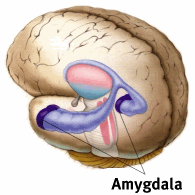
Australian scientists have found out what part of the brain is responsible for sexual attraction between people. They also found out that the bigger that part of the brain is, the faster and more intense man's excitement is.
The researchers, a group of neurophysiologists from the University of Melbourne, say that the degree of excitement depends upon the activity of the part of the brain called 'amygdala'. This part of the brain has the size of an almond. When you feel sexual irritants, the amygdala will respond faster than any other part of the brain.
Before the researchers discoverd this, it was already believed that the amygdala was responsible for attraction between animals.
After examining 45 epilictics of whom part of the brain is not working, amygdala included, it turned out that the amygdala plays a large role in the sexual experience. The bigger the amygdala, the bigger the sexual lust. People with large parts of the amygdala not functioning were almost indifferent to sex.
 RSS Feed (xml)
