LUST IS EXTRA DIMENTION WHICH CREATE DYNAMIC POWER TO LOVE> LOVE IS SIMPLE AND PLEASE>
Showing posts with label lust science. Show all posts
Showing posts with label lust science. Show all posts
Saturday, June 26, 2010
Friday, March 7, 2008
Lust :Sex chemistry lasts two years max. And?

Been in a relationship longer than a couple of years? First flush of romance worn off? Well, duh. For some reasonworked hard to identify the specific hormones which downgrade your libido from "passionate lust" to "let's just cuddle".
The team from the University of Pisa, Italy, discovered that hormones called neutrophins are responsible for the slowly diminishing sense of lust, with those in the first flush of romance showing much higher levels.
Dr. Petra Boynton of the British Psychological Society hastened to add that this did not mean the first flush is the best bit
She cautioned that we should not necessarily attempt to revisit that, since the settled relationship feelings can be much more valuable and was concerned that the research would lead to attempts to synthesise these hormones.
Testosterone also increases in loved-up women, and decreases in loving men; couples who had been in a relationship for between one and two years had decreased "love molecules", though the relationships were functioning well. Instead, increased levels of oxytocin, the chemical the induces labour and milk production in new and pregnant mothers, were found in the couples and that's the secure cuddle factor.
I suspect anyone in a long term relationship will be wondering how they can report this to the Department of the Bleedin' Obvious around now
Sunday, December 30, 2007
Lust Facts :Always aroused: A good thing gone awry

we should all be careful what we wish for when we are wishing for more feelings of desire. “Anything unrelenting is torture.”
Suze has begun conversations with doctors this way: "I want to talk to you about something, but you have to give me your word you will not laugh or give a flippant response because it is a serious situation."
In short, Suze has too much of a good thing. For days, sometimes weeks at a time, she feels constantly aroused, but can't get any satisfaction.
Despite the preamble, though, "one doctor looked at me and said, 'What a lucky man your husband is! I wish my wife had this,'" says Suze, 63, a retired nurse in Florida. Others have asked, "So, is this like being a nymphomaniac?"
Hardly. Suze, who asked that her last name not be published, has what is now called persistent genital arousal disorder, or PGAD. It was first named by sex therapist Sandra Leiblum in 2001 as persistent sexual arousal syndrome, but as Leiblum and others have begun studying patients, she decided that it was more a disorder than a syndrome, a syndrome being a constellation of symptoms that suggest the presence of true disease.
In a recent article in the Journal of Sexual Medicine, Leiblum and her co-authors identified a series of medical and psychological traits, including depression and panic attacks, that can accompany PGAD. Though some women are helped by psychiatric drugs, Leiblum strenuously resists the idea that the problem is necessarily psychological. “I do think there is always some organic contribution, but we just do not know what it is.”
Exactly what it is remains murky, but Suze’s symptoms, like that of other sufferers, involves a feeling of "fullness" — a constant engorgement — of the genitals that is unprompted by erotic thoughts or feelings.
"I could be in the middle of a tennis game [or] playing canasta," Suze says, "and then suddenly have this intense urge for intimacy. I could masturbate five times or 105 times and it would only make it worse."
Leiblum, who is now in private practice in Bridgewater, N.J., and treats a wide variety of sexual and relationship complaints, says her description of the disorder did not occur until 2001 because, like most sex therapists (and sex columnists), she heard many more complaints about lack of desire and arousal than she ever heard about too much of it.
Some women with PGAD tried approaching doctors, Leiblum says, but “I took it seriously and listened to what women were telling me. I said to myself, ‘This is bizarre and different from anything else I have heard of,’ but I believed what women told me rather than writing them off.”
Nobody knows how many women might suffer from PGAD. And the feeling of genital arousal is not always unwelcome. Some women like it. But if it is not causing distress, it is not considered a disorder, and so such women cannot be said to truly have PGAD. The ones who do describe a living hell.
Just repressed?
Heather Dearmon, a 33-year-old housewife and mother in South Carolina, became so desperate she voluntarily had herself committed — twice — to psychiatric institutions. “One psychiatrist said I must be sexually repressed and needed to experiment more," she says. "He suggested I try lesbianism.”
Her symptoms began during her pregnancy with her son. She asked her ob-gyn, who suggested that the pregnancy may have played havoc with Dearmon’s hormones and advised waiting it out, hoping the urges would subside after the birth. “But the day after I gave birth they came back,” she recalls.
The feelings were so intense and so persistent that she was unable to ignore them or even carry out daily functions. “It got to the point where morning, afternoon and night I had to take care of it. But the more you masturbate, the more you desensitize yourself so it would take a good hour to have three orgasms. This is at the point when I started to become suicidal. My whole life was being robbed from me.” She began pushing her husband away because she treasured any time she was not feeling aroused.
Finally, with her fears mounting over plans for a long family car trip, a doctor prescribed the anti-anxiety medication Paxil. Soon after beginning dosing herself, she found the urges became less frequent. Now, she can go up to 10 days without having to masturbate, though by day seven the arousal, focused on her clitoris, is often severe.
Why this happens remains a mystery. Research is still at an early stage, but some tantalizing hints have begun to emerge. One of Leiblum’s collaborators in England has found that some women complaining of PGAD can have concomitant conditions like a yeast infection or a dermatological outbreak around the genitals. But Leiblum stresses that the only thing for sure is that both can happen at the same time, not that one causes the other.
Sometimes biofeedback techniques can help, suggests sex researcher Beverly Whipple. “A couple of women were very successful,” she says.
Sex and the brain
Whipple, Leiblum and Rutgers University psychology professor Barry Komisaruk (Whipple’s co-author of their 2006 book, "The Science of Orgasm") are currently using MRIs to examine the brains of women suffering from PGAD in hopes of discovering how the central nervous system might play a role.
The PGAD mystery is just one of several linking the brain with too much arousal. One woman had spontaneous orgasms while brushing her teeth though she did not have orgasms while having intercourse or masturbating. The tooth brushing apparently triggered epileptic seizures that, in turn, caused the orgasms. (People with epilepsy sometimes do experience what is called “orgasmic aura.” In some cases, patients have been known to refuse treatment because they like the sensations.) Another woman had orgasms due to a vascular abnormality in her brain.
Men with obsessive-compulsive disorder have been known to have unwanted and unexpected erections. Parkinson’s patients can become hypersexual. So can people with brain injuries.
Men with a condition called priapism also can have too much of a good thing. Those constant reminders at the end of commercials for impotence drugs tell men that if they have an erection lasting four hours or longer they should seek medical advice. What they don’t say is that you might have priapism, an erection that simply won’t go away. Unlike PGAD, priapism does not usually result in a man craving release, it’s just very painful, a hydraulic malfunction that can be treated by — have a seat men — sticking a needle into the penis to draw blood out.
But even that gruesome scenario is nothing compared to what some of the women suffering from PGAD say they have experienced.
Friday, November 2, 2007
Lust, not love, the driving factor behind sex
 RESEARCHERS in the US have found that the motivation for having sex is largely the same for men and women, seemingly shattering the myth that the genders have different reasons for racing to the bedroom.
The researchers compiled a list of 237 reasons given by US college students for getting frisky - and the top reasons for men and women were more to do with lust than a deep love connection.
 What are your top reasons? Is it all over after uni?
Tell us using the form below »
The findings would apparently contradict the assumption by some that it is only men who are motivated by lust, whereas women only want sex as an expression of a deep emotional feeling.
Seven of the top 10 reasons for men revolve around the pleasure of the act. The top response was "I was attracted to the person", while "It feels good", "It's fun" and "I wanted to experience pleasure" were also in the top four.
For women, the top response was the same: "I was attracted to the person". Six of the remaining nine answers in the top 10 were also centred on the women feeling pleasure from the act.
Three of the top 10 reasons for men and women involved providing pleasure to the partner. For women, those reasons rated slightly higher on the leaderboard.
The study was compiled - and paid for - by researchers at the University of Texas over five years and published in the August edition of the journal Archives of Sexual Behaviour.
"It's refuted a lot of gender stereotypes ... that men only want sex for the physical pleasure and women want love," University of Texas clinical psychology professor Cindy Meston, the study's co-author, told the Associated Press.
"That's not what I came up with in my findings. None of the gender differences are all that great.
"Men were more likely to be opportunistic towards having sex, so if sex were there and available they would jump on it, somewhat more so than women. Women were more likely to have sex because they felt they needed to please their partner."
Another expert who was not involved in the study said its findings backed up other research suggesting the often-assumed sexual differences between men and women were only factors for those with sexual problems.
Prof Meston did concede, however, that the study's focus on university students - whose "hormones run rampant" - might have affected the findings.
She said more differences may emerge as people grow older.
The bottom five reasons given by men and women were surprisingly vindictive, ranging from "I wanted to punish myself" or "I wanted to end my relationship" to "I wanted to give someone else a sexually transmitted disease".
Benefits also figured in the bottom rungs of the list. "I wanted to get a job" was fifth from bottom for men, while "The person offered to give me drugs for doing it" was the very lowest ranked.
"I wanted to get a job" and "I wanted a raise" were among the bottom reasons given by women.
Most people have loves of varying types - of Love and Lust
 Thinking a lot about love. Like almost any human being, I've had plenty of encounters with love - but I'm not really sure I understand what it is. Love takes many forms. A parent loves a child, a child loves a parent, a sister loves a brother, a man loves his wife or partner, and people love their pets, etc. A person might love chocolate, or gardening, an automobile, a sport, sex, clothes, tools, wine or poetry - or a religion, an intellectual pursuit, a language, or physics.
Most people have loves of varying types - and often love feels like a positive thing, but not always. Love can feel suffocating, hurtful, toxic or destructive to the lover, the beloved, or both. Love contains a complex range of emotional possibilities - it can feel like a cuddly bundle of joy one moment and a howling terror the next. Love can gestate over months or years, or appear suddenly on an unsuspecting person's doorstep… wanted or unwanted. It takes love to provide a blueprint and job experience for a family.
I've known men who said they loved me, and a few whose actions demonstrated affection whether they professed love or not. At times I've believed that I loved a man, only to discover the illusory nature of the experience and the selective or deceptive nature of my perceptions. I suspect that men inflict as much harm on fellow men in the name of love as they do in the name of war, only subtly. Some folks speak of "tough love," and some people speak of a nebulous "love for humanity" as though love constitutes a God-given or universally recognized permission slip to inflict one's desires and demands upon others.
When a man forces his sexual will onto an unwilling partner, we call that rape - or a gang rape, when a group of men participates. Yet when a man or a group of men force their political demands onto unwilling people folks call that good citizenship. A group of men who demand a society free of drugs stop at nothing to achieve it - even when the old and the terminally ill suffer, and they may soon insist on regulating people's vitamin use too. "We'll hurt you and you'd better thank us for it" seems an apt motto for this sort of lusty fanaticism. A drug-free society means a lot of unhappy people forced to endure a lot of pain, or driven to black market dealers - that's brotherly unkindness, not brotherly love.
A group of men determined to free the world of other people's tyrannies will enslave the world for the sake of their own and call that freedom. They're good citizens, and when I exercise self-restraint by not voting, I'm a slacker. At least I'm still free to OD on disgust. If abstinence from casual sex is responsible, how can abstinence from sleazy politics be irresponsible? If I refuse to show up at the voting booth to take my marginal crap-shot at infecting an entire society with politically transmitted social afflictions, I'm irresponsible because I prefer not to inflict high-risk political behavior onto everybody else? Get thee away from my backside, Satan… please keep your dirty political leverage to yourself.
I'm ready to reclaim the word "love" for general usage by reclaiming the word "lust" for general usage as well. What does "tough love" mean, if not unbending lust for assuming positions of political dominance or moral superiority over other people? What does "love for humanity" usually mean, if not condescending lust to nourish one's ego at the expense of a bemused world which might prefer benign tolerance to inadvertent ego-stroking for smugly paternalistic philanthropists of any and all persuasions or orientations?
Lust gets a bad rap as one of the seven deadly sins, and for good reason - yet lust drives the sensible man toward admirable behavior, while love tows the silly man into foolish behavior. If lust can challenge a man to behave well while love can provoke a man to behave badly, does it seem reasonable to consider lust bad and love good? Maybe some deeper meaning got lost in translation… maybe so many tongues stirring the pot spoil the alphabet soup called language that people use to communicate. How can the dead letter kill unless people voluntarily or involuntarily swallow it as a poison? How can the spirit or the Word give life unless people ingest it as an antidote to dead letter poisoning?
I'm tired of seeing lust masquerade as love, giving love a bad name, when lust and love cohabitate along the same spectrum of emotions. Apparently lust - in the "deadly sin" sense - represents a debased form of love that ceases to observe conscientious boundaries and forces itself onto others in unloving, and not necessarily sexual, ways. Conversely, love represents a refined form of lust capable of elevating a mere human being beyond lowlier forms of lust, and above coercive expressions of human desire or affection.
Lust forces itself on unwilling partakers, in other words, while love doesn't - or what's the meaningful difference? It seems wise to preemptively master our own deadly lusts long before they betray us into attacking genuine forms of love that we may not be capable of recognizing because we can't accurately distinguish love from lust. Perhaps that's not our judgment call anyway. The forms of love that busybodies seem most eager to stick their uppity noses into appear to be consensual adult relationships where busybodies are least wanted - and that's obscene.
Thursday, October 25, 2007
Lust for sex is depand on Size of brain
Lust for sex is a common factor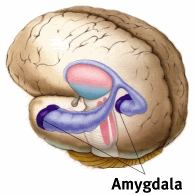
Australian scientists have found out what part of the brain is responsible for sexual attraction between people. They also found out that the bigger that part of the brain is, the faster and more intense man's excitement is.
The researchers, a group of neurophysiologists from the University of Melbourne, say that the degree of excitement depends upon the activity of the part of the brain called 'amygdala'. This part of the brain has the size of an almond. When you feel sexual irritants, the amygdala will respond faster than any other part of the brain.
Before the researchers discoverd this, it was already believed that the amygdala was responsible for attraction between animals.
After examining 45 epilictics of whom part of the brain is not working, amygdala included, it turned out that the amygdala plays a large role in the sexual experience. The bigger the amygdala, the bigger the sexual lust. People with large parts of the amygdala not functioning were almost indifferent to sex.
Monday, October 8, 2007
Lust free Living
Lust Free Living is a small-group curriculum for Christian men and women who struggle with lust and sexual issues. It was developed as a short, easy to read, blunt, honest and direct way for Christian men and women to talk about sexual issues. It is Biblically sound and walks men through actual, solid, concrete help. A Coaching Guide with videos for each chapter is available to set the tone for maximum effectiveness.
more
The sin of LUST
Lust Sinopsis
What it is: Lust is an inordinate craving for the pleasures of the body.
Why you do it: Oh, please.
Your punishment in Hell will be: You'll be smothered in fire and brimstone. Not kisses.
Associated symbols & suchlike: Lust is linked with the cow and the color blue
............................................................................................................................................................................
References
Medieval theologian Thomas Aquinas said of Lust:
...wherever there occurs a special kind of deformity whereby the venereal act is rendered unbecoming, there is a determinate species of lust. This may occur in two ways: First, through being contrary to right reason, and this is common to all lustful vices; secondly, because, in addition, it is contrary to the natural order of the venereal act as becoming to the human race: and this is called "the unnatural vice." This may happen in several ways. First, by procuring pollution, without any copulation, for the sake of venereal pleasure: this pertains to the sin of "uncleanness" which some call "effeminacy." Secondly, by copulation with a thing of undue species, and this is called "bestiality." Thirdly, by copulation with an undue sex, male with male, or female with female, as the Apostle states (Rm. 1:27): and this is called the "vice of sodomy." Fourthly, by not observing the natural manner of copulation, either as to undue means, or as to other monstrous and bestial manners of copulation.
The Travelers' Guide to Hell says
Lust is ruled by the celestial sign of Venus. Incidentally, this is the first book to mention the Seven Deadly Sins Homepage. I urge you to buy several copies and distribute them to all your friends. I would kiss both authors on the mouth if they would have me.
We at the Seven Deadly Sins Homepage care about you. So if you think you might be tempted to engage in a monstrous and/or bestial manner of copulation, or if you find yourself procuring some pollution without any copulation, thereby rendering yourself effeminate (as "unclean" is no longer considered an appropriate term), get help.
Take the Lust Test to determine your temptability. Carefully follow the instructions to bring some healing to your perverse soul. If you really try, maybe you can make it into the upcoming "Souls Saved By this Site" feature
List of Sin
Pride is excessive belief in one's own abilities, that interferes with the individual's recognition of the grace of God. It has been called the sin from which all others arise. Pride is also known as Vanity.
Envy is the desire for others' traits, status, abilities, or situation.
Gluttony is an inordinate desire to consume more than that which one requires.
Lust is an inordinate craving for the pleasures of the body.
Anger is manifested in the individual who spurns love and opts instead for fury. It is also known as Wrath.
Greed is the desire for material wealth or gain, ignoring the realm of the spiritual. It is also called Avarice or Covetousness.
Sloth is the avoidance of physical or spiritual work.
Sunday, October 7, 2007
Am I in Love?
How to Know if You're Really in Love
It is a very common question, "How can I tell I'm in love?", but it is not an easy question to answer. What feels like love to one person may be nothing more than attraction to another. Some people fall in and out of love quickly and often while others are never really in love as much as they are in lust. This can get confusing when you are a teen because romantic love is a relatively new concept for you and you don't know what to expect. You are overwhelmed with all sorts of new feelings and social pressures. They are confusing. What is love? What makes you want a romantic relationship with one person and not another? How does your heart choose a partner? Why does love end? These questions can't be easily answered.
One of the most confusing quasi-love feelings is lust. Lust is a very powerful, very intense feeling of physical attraction toward another person. Lust is mainly sexual in nature - the attraction is superficial based on instant chemistry rather than genuine caring. Usually we lust after people we do not know well, people we still feel comfortable fantasizing about. It is very common for people to confuse lust for love. But why? What is it about lust and love that make them so easy to mix up? If lust is all about sex, how can a relationship without sex be about lust? Teens struggle with this because they see lust in the Biblical sense, but lust isn't that sinister. Lust is about physical attraction and acting ONLY on physical attraction. Love is about much more than that. Yet many teens (and to be fair, many adults) confuse an intense attraction for some sort if divine love. For teens, since feelings of attraction are still new and since pop-culture sells sex and love as one package, it is very easy to get the two mixed up.
Lust is clearly not love. Love is based on more than just physical attraction. Sure, attraction is a factor, but love goes deeper than that. Love is based on caring, friendship, commitment and trust. When you are in love it is as if you have your best most trusted friend at your side AND you feel physically attracted to them. It is the best of both worlds! Love is a shared feeling between two people who have a vested interest in one anothers happiness. Love is not about jealousy. It is not about conflict. It is not about testing. Love is a positive feeling. If it is tainted by mistrust, jealousy, insecurity or spitefulness it is not really love but merely a pale copy. Love is the total surrender of your heart to another person with the security of knowing they will treat it better than you will. Love should feel good. It should not feel bad. Love should make you want to be a better person, it should not lead you to do something self destructive. Love is not demanding of your spirit but lifts it and makes it glow. Love is a good thing. Anything less is lust, deep friendship or attraction. So the sappiness aside, the question remains, how can you tell you are in love?
There is no easy way to find the truth behind your feelings or the feelings of another person but there are some tell-tale signs that love is blooming (or growing deeper). If you agree with 7 of the following 9 statements you are probably in love.
You know, because you have been told by your significant other, that your deep feelings are returned in kind.
The object of your affections makes you feel special and good about yourself.
If/when you feel jealous it is always fleeting; you trust your partner not to betray you or hurt your relationship.
Nothing makes you feel as serene as when you and your partner are together.
When you fight with your partner you usually make up within a few hours and you always agree that nothing is more important than you both being able to express your true feelings (even if they sometimes cause conflict).
Your partner never asks you to choose between him/her and your loyalties to your family and friends - if you do choose him/her over them you always have a good reason and it is always YOUR decision, and your decision alone.
Neither you or your partner feel the need to test the other's loyalties or feelings.
You are more yourself when with your partner than you are with anybody else.
If sex is part of your relationship it is by mutual desire and agreement without the slightest hint of commitment testing or persuasion.
Lust

What is lust??
Lust is everything,
I will say lust is the power of the generative world.
Lust is any intense desire or craving for self gratification. Lust can mean strictly sexual lust, although it is also common to speak of a "lust for life", "lust for blood (bloodlust for short)", or a "lust for power" or other goals. The Greek word which translates as lust is epithymia (επιθυμια), which also is translated into English as "to covet
Etymology
The word is derived from the Old English term for desire, and ultimately from a Germanic which also originated High German lust ('wish, desire'). In German, the word Lust denotes simply "desire".
Obsolete uses include lust in the sense of pleasure, or relish.
Lust in the context of religion
Christianity—General
Catholic tradition considers lust to be one of the main sins or vices.
Christianity—Roman Catholicism
Roman Catholic Church teaches that lust is one of the seven capital vices, popularly known as the seven deadly sins. A vice, according to this tradition, is a "habit inclining one to sin" [1]. The specific sins to which lust may lead are fornication, adultery, incest, criminal assault, abduction, sodomy, rape, and others. [2]. However, "Such guilt as [one] may have contracted in any case is charged directly to the sinful act, not to the vice;" [3] in other words, it is the specific sins, and not the vice itself, which deprive one's soul of sanctifying grace and make one deserving of God's punishment.
Punishment in the afterlife
According to some Christian sources [4], reprobates whose chief unforgiven sin is lust are punished in Hell by being "smothered in fire and brimstone." However, while most Christian traditions agree that at some point after death the damned individuals find themselves in a hell where they suffer punishment for their sins, most traditions also agree that one can only speculate regarding the precise nature of any punishment above and beyond the principal torment, which comes simply from being totally separated from God.
Repentance in Purgatory
According to The Divine Comedy, penance who are guilty of lust cleanse their soul of the sin by walking through flames, thereby purging their minds of all lustful thoughts.
Subscribe to:
Posts (Atom)
 RSS Feed (xml)
