
Showing posts with label lust factor. Show all posts
Showing posts with label lust factor. Show all posts
Saturday, August 16, 2008
Friday, March 7, 2008
Lust :Sex chemistry lasts two years max. And?

Been in a relationship longer than a couple of years? First flush of romance worn off? Well, duh. For some reasonworked hard to identify the specific hormones which downgrade your libido from "passionate lust" to "let's just cuddle".
The team from the University of Pisa, Italy, discovered that hormones called neutrophins are responsible for the slowly diminishing sense of lust, with those in the first flush of romance showing much higher levels.
Dr. Petra Boynton of the British Psychological Society hastened to add that this did not mean the first flush is the best bit
She cautioned that we should not necessarily attempt to revisit that, since the settled relationship feelings can be much more valuable and was concerned that the research would lead to attempts to synthesise these hormones.
Testosterone also increases in loved-up women, and decreases in loving men; couples who had been in a relationship for between one and two years had decreased "love molecules", though the relationships were functioning well. Instead, increased levels of oxytocin, the chemical the induces labour and milk production in new and pregnant mothers, were found in the couples and that's the secure cuddle factor.
I suspect anyone in a long term relationship will be wondering how they can report this to the Department of the Bleedin' Obvious around now
Sunday, December 30, 2007
Lust Facts :Always aroused: A good thing gone awry

we should all be careful what we wish for when we are wishing for more feelings of desire. “Anything unrelenting is torture.”
Suze has begun conversations with doctors this way: "I want to talk to you about something, but you have to give me your word you will not laugh or give a flippant response because it is a serious situation."
In short, Suze has too much of a good thing. For days, sometimes weeks at a time, she feels constantly aroused, but can't get any satisfaction.
Despite the preamble, though, "one doctor looked at me and said, 'What a lucky man your husband is! I wish my wife had this,'" says Suze, 63, a retired nurse in Florida. Others have asked, "So, is this like being a nymphomaniac?"
Hardly. Suze, who asked that her last name not be published, has what is now called persistent genital arousal disorder, or PGAD. It was first named by sex therapist Sandra Leiblum in 2001 as persistent sexual arousal syndrome, but as Leiblum and others have begun studying patients, she decided that it was more a disorder than a syndrome, a syndrome being a constellation of symptoms that suggest the presence of true disease.
In a recent article in the Journal of Sexual Medicine, Leiblum and her co-authors identified a series of medical and psychological traits, including depression and panic attacks, that can accompany PGAD. Though some women are helped by psychiatric drugs, Leiblum strenuously resists the idea that the problem is necessarily psychological. “I do think there is always some organic contribution, but we just do not know what it is.”
Exactly what it is remains murky, but Suze’s symptoms, like that of other sufferers, involves a feeling of "fullness" — a constant engorgement — of the genitals that is unprompted by erotic thoughts or feelings.
"I could be in the middle of a tennis game [or] playing canasta," Suze says, "and then suddenly have this intense urge for intimacy. I could masturbate five times or 105 times and it would only make it worse."
Leiblum, who is now in private practice in Bridgewater, N.J., and treats a wide variety of sexual and relationship complaints, says her description of the disorder did not occur until 2001 because, like most sex therapists (and sex columnists), she heard many more complaints about lack of desire and arousal than she ever heard about too much of it.
Some women with PGAD tried approaching doctors, Leiblum says, but “I took it seriously and listened to what women were telling me. I said to myself, ‘This is bizarre and different from anything else I have heard of,’ but I believed what women told me rather than writing them off.”
Nobody knows how many women might suffer from PGAD. And the feeling of genital arousal is not always unwelcome. Some women like it. But if it is not causing distress, it is not considered a disorder, and so such women cannot be said to truly have PGAD. The ones who do describe a living hell.
Just repressed?
Heather Dearmon, a 33-year-old housewife and mother in South Carolina, became so desperate she voluntarily had herself committed — twice — to psychiatric institutions. “One psychiatrist said I must be sexually repressed and needed to experiment more," she says. "He suggested I try lesbianism.”
Her symptoms began during her pregnancy with her son. She asked her ob-gyn, who suggested that the pregnancy may have played havoc with Dearmon’s hormones and advised waiting it out, hoping the urges would subside after the birth. “But the day after I gave birth they came back,” she recalls.
The feelings were so intense and so persistent that she was unable to ignore them or even carry out daily functions. “It got to the point where morning, afternoon and night I had to take care of it. But the more you masturbate, the more you desensitize yourself so it would take a good hour to have three orgasms. This is at the point when I started to become suicidal. My whole life was being robbed from me.” She began pushing her husband away because she treasured any time she was not feeling aroused.
Finally, with her fears mounting over plans for a long family car trip, a doctor prescribed the anti-anxiety medication Paxil. Soon after beginning dosing herself, she found the urges became less frequent. Now, she can go up to 10 days without having to masturbate, though by day seven the arousal, focused on her clitoris, is often severe.
Why this happens remains a mystery. Research is still at an early stage, but some tantalizing hints have begun to emerge. One of Leiblum’s collaborators in England has found that some women complaining of PGAD can have concomitant conditions like a yeast infection or a dermatological outbreak around the genitals. But Leiblum stresses that the only thing for sure is that both can happen at the same time, not that one causes the other.
Sometimes biofeedback techniques can help, suggests sex researcher Beverly Whipple. “A couple of women were very successful,” she says.
Sex and the brain
Whipple, Leiblum and Rutgers University psychology professor Barry Komisaruk (Whipple’s co-author of their 2006 book, "The Science of Orgasm") are currently using MRIs to examine the brains of women suffering from PGAD in hopes of discovering how the central nervous system might play a role.
The PGAD mystery is just one of several linking the brain with too much arousal. One woman had spontaneous orgasms while brushing her teeth though she did not have orgasms while having intercourse or masturbating. The tooth brushing apparently triggered epileptic seizures that, in turn, caused the orgasms. (People with epilepsy sometimes do experience what is called “orgasmic aura.” In some cases, patients have been known to refuse treatment because they like the sensations.) Another woman had orgasms due to a vascular abnormality in her brain.
Men with obsessive-compulsive disorder have been known to have unwanted and unexpected erections. Parkinson’s patients can become hypersexual. So can people with brain injuries.
Men with a condition called priapism also can have too much of a good thing. Those constant reminders at the end of commercials for impotence drugs tell men that if they have an erection lasting four hours or longer they should seek medical advice. What they don’t say is that you might have priapism, an erection that simply won’t go away. Unlike PGAD, priapism does not usually result in a man craving release, it’s just very painful, a hydraulic malfunction that can be treated by — have a seat men — sticking a needle into the penis to draw blood out.
But even that gruesome scenario is nothing compared to what some of the women suffering from PGAD say they have experienced.
Tuesday, October 23, 2007
Sex genes in addiction? :Study links faster habit formation in females with genes on sex chromosomes
 "I think [the study is] very cool," said Ronald See at the Medical University of South Carolina, who was not involved in this research. The investigators have established a simple method for teasing out sex and hormonal differences that can now be applied to behavioral tests, he said.
Sex differences in addictive behavior, long linked to female hormones, may also be driven by genetic factors, according to a new study published online in Nature Neuroscience.
A now-classic study that compared male and female responses to cocaine showed that females were more sensitive to the drug's reward effects during the estrus phase of their menstrual cycle, establishing the theory that hormone levels influence addictive behavior. But the contribution of sex chromosomes was not previously examined because there was no technique for separating hormonal factors from genetic ones.
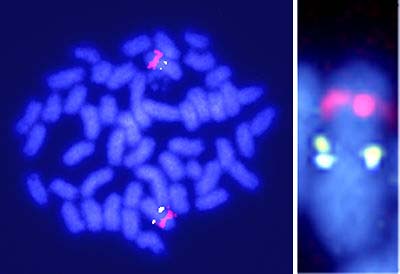
Jane Taylor of Yale University and colleagues identified a naturally occurring mutant mouse in which males lacked a gene on the Y chromosome called SRY that is responsible for the formation of testes. These mutants, while chromosomally male, did not develop testes. The researchers then inserted the SRY gene onto an autosomal chromosome of a mutant male -- which developed normal testes -- and crossed that animal with a normal female. The resulting strain consisted of four phenotypes: genetic males with testes; genetic males with ovaries; genetic females with ovaries; and genetic females with testes.
"Until this mouse model we didn't have a way of addressing this issue," first author Jennifer Quinn, also from Yale, told The Scientist.
The researchers examined the speed with which the gonad-crossed mice formed a habitual behavior in response to food. The mice were trained to poke their noses in one of three holes in order to receive food. But when they were taught that the food was no longer tasty, genetically female mice -- regardless of their gonadal status -- continued the nose-poking behavior out of habit, even though they stopped eating the food. (When trained long enough, all four phenotypes developed the habit.)
The study doesn't contradict the body of data that implicates hormones like estrogen and progesterone in addictive behaviors, said Quinn, but it is the first demonstration there may be a sex-linked genetic component as well.
Teasing out addictive behaviors that are more strongly associated with sex-related genes could allow scientists to look for specific X-linked or Y-linked genes that could be targets for addiction therapies, said Quinn.
But she added that the study only indirectly addressed addiction behavior, since the researchers used a food response rather than a drug of abuse. While she plans to test responses to drugs of abuse using this experimental model, she said the results suggest that depression and conditions such as Tourette's syndrome, which have components of compulsive behavior, might also be affected by sex chromosomes.
Wendy Lynch from the University of Virginia, who was not involved in the study, said the research addressed a component of addiction that hasn't been given much attention. Most studies on drug addiction have focused on the initial reward -- the euphoric feeling -- that comes with satisfying a craving, but this work instead looked at habitual or compulsive behavior that contributes to addiction but often sets in later.
The results give a "hint or suggestion that females could develop compulsive behavior faster," Lynch said.
"It could certainly have implications on how learning [in general] takes place," as well as other motivation behaviors, See said.
"It really makes you wonder what else might be going on here," said Lynch. "I think there's going to be a lot of work that follows on this. I think it's going to be exciting."
Monday, October 22, 2007
SEPARATING LUST AND LOVE # 1

. LUST—RESPONDING TO IMPRINTED SEXUAL FANTASIES
A. Where Does Lust Come From?
Lust is the sexual feeling we find arising within ourselves
when we meet a person who triggers our sexual responses.
Our sexual responses were imprinted into us at an early age
—probably before age 20 and perhaps most importantly during adolescence.
We might like to think that our sexual responses came from our animal ancestors,
but that would not explain why we are aroused by
words, stories, myths, settings, clothing, etc.
We get 'turned on' by all kinds of things that have strong symbolic content,
which is not possible for the other animals,
since they do not use abstract symbols.
But it seems safe to assume that human lusting
has been happening for at least 100,000 years,
which marks the beginning of our symbolic capacity
and the emergence of human language.
These early humans probably had different sexual imprinting,
but they were probably 'turned on' by sexy stories just as we are.
Which people really 'turn us on'
—even if we do not know them personally?
What are our best lust-objects?
Heterosexual males find themselves sexually attracted
to conventionally-sexy females.
Heterosexual females find themselves sexually attracted
to conventionally-sexy males.
Just switch the lust-objects for most homosexual males and females.
We grow up knowing that we lust after certain kinds of people.
--------------------------------------------------------------------------------
B. Does Our Lust-Response Change and Mature Over a Life-Time?
When we were teen-agers we lusted after others our own age.
And it now appears that those we lusted for in our youth
remain inside our sexual brains for the rest of our lives.
Thus as our bodies and minds get older and more mature,
our sexual responses do not mature along with us.
We still find ourselves 'turned on' by the images that aroused us in our teen years.
We might find ourselves torn between
the mature adults we have become in every other way
and the 'adolescent' sexual responses that still control our sexual brains.
--------------------------------------------------------------------------------
C. How Should We Respond to the Lust We Find within Ourselves?
Even tho we discover that we cannot change the lusty stories in our brains,
we are always responsible for the sexual behavior we create from those impulses.
Some of us experience no conflict between our sexual imprinting
and the behavior that naturally follows from it.
We might actually enjoy the resulting sexual behavior.
But if as we become more mature adults,
we do not like the specific sexual response we find within ourselves,
then we have the difficult task of re-creating our sexuality
so that it reflects more the persons we have become in adulthood
than the teen-agers we were some years ago.
--------------------------------------------------------------------------------
II. ROMANTIC LOVE—HOW OUR HEARTS WERE TRAINED TO 'FALL IN LOVE'.
One of the most common alternatives to lusting is loving.
But the kind of love we usually mean is romantic love,
which also might lead us into problems.
A. Where Does Romantic Love Come From?
Just as we might like to believe that our human sexuality is 'natural',
so we usually assume that 'falling in love' comes naturally.
But historical investigation has discovered
that what we know as romantic love is only about 800 years old.
This seems shocking and impossible to us as first,
since we know that people have been mating and reproducing for millions of years.
But if we clearly separate lust from love,
we can see that lust might have accounted for the sexual behavior of our ancestors
even if they could never have understood a romantic Hollywood movie.
Romantic love is a cultural construct,
which has been spread over the whole Earth by the mass media.
Before radio, television, and movies—100 years ago—
large parts of the world had never heard of 'falling in love'.
They still had sexual relationships and families, of course,
but the fantasy of romantic love did not run their relationships.
Romantic love is basically an emotional story we tell ourselves.
By means of the mass media, we have been programmed
so that we 'fall in love' following the patterns prescribed in the Hollywood script.
We try to reproduce a fantasy feeling.
We 'fall in love' with the Dream Lover we brought with us
when we set out to find "someone to love".
--------------------------------------------------------------------------------
B. Does Our Romantic Response Change and Mature Over a Life-Time?
Because we have learned how to 'fall in love' from the surrounding culture,
it is also possible to unlearn this emotional programming.
However, if we are enjoying the game of romance,
we might not want to be awakened from that dream.
Only when the romantic delusion starts to fall apart
do we begin to look for more mature ways of loving.
So, at least for some people, romantic love can be replaced by relationships
not based on emotional responses learned from the culture
but based on the two persons as they are re-inventing themselves to be.
Meaningful loving relationships can be created
completely beyond the romantic mythology.
--------------------------------------------------------------------------------
C. How Should We Respond to the Romantic Feelings We Find within Ourselves?
Many of us have few problems with the romantic responses we experience.
We enjoy the game of falling in and out of love.
And we will continue to seek new romantic adventures for the rest of our lives.
We might decide that the game of romance is harmless,
as long as all players realize
that they are trying to re-create a story they saw on television.
But after a few more cycles on the merry-go-round of love,
we might ask whether we want to repeat this fantasy-script.
A more mature response can leave the romantic fantasies behind
and proceed to create relationships beyond romantic illusions.
--------------------------------------------------------------------------------
III. BEYOND BOTH LUST AND LOVE—CREATING UNIQUE RELATIONSHIPS.
A. Where Do Relationships Come From?
As strange as it might seem to some people at first,
it is possible to create relationships beyond our imprinted sex-scripts (the lust response)
and beyond our emotionally-programmed romantic feelings (the love response).
These relationships will be based in something much more substantial
—in the new persons we are creating ourselves to be.
In other words, loving relationships based in Authenticity
emerge from the actual interaction of two people who are building that relationship.
Piece by piece, we can create new patterns of being together
that have never been attempted before.
We are not prisoners of our imprinted sex-scripts.
We do not need to replicate romantic feelings we leaned from the movies.
What we choose as our central purposes in life
can also become central to our loving relationships.
In freedom we can re-create our selves—and our relationships.
--------------------------------------------------------------------------------
B. Do Our Loving Relationships Change and Mature Over a Life-Time?
When our loving relationships are based on our own free choices
rather than our imprinted sexual fantasies
or the romantic traditions we picked up from society,
then we are also free to change our relationships as the years go by.
In fact, it is very likely that we will create new dimensions of our relationships
while we let some older aspects die away as no longer meaningful.
If we become more Authentic in new ways,
those changes will also show themselves in our relationships.
Our sexual responses will probably remain the same.
And the romantic tradition will continue into the foreseeable future.
But as free persons, we can create new kinds of relationships.
--------------------------------------------------------------------------------
C. How Do We Conduct and Transform Our Loving Relationships?
When we were still allowing our connections with others
to be shaped by our sexual responses and our romantic dreams,
we had to fight against these influences
if we wanted to do anything that was definitely our own.
But once we begin to re-invent love for the two persons we are and are becoming,
then the next phase of our relationship will be whatever we decide it will be.
We conduct our relationship by making daily decisions
about what we will do together.
And we make major transformations of our relationship
by discussing and deciding what new things we will try.
With each new experiment in our relationship,
we will evaluate the results as seen from both sides.
We will abandon the changes that did not work for us.
And we will continue and develop the new dimensions that we both like.
Lusting and 'falling in love' are only the beginning.
After we get beyond sex and romance,
we can use our creativity to re-invent love.
SEPARATING LUST AND LOVE

Connecting with other persons is an important dimensions of living.
One of the first things that draws us to other people is our sexual response.
But because lust responds to abstract characteristics of the other,
we might find simple sex a deficient basis for an on-going relationship.
Parallel to our sexual responses we also find ourselves 'falling in love'.
This emotional response has deep roots in our Western culture.
But romantic love is also a deficient basis for a meaningful relationship.
Beyond lust and love, it is still possible to create relationships
based on the persons we are inventing ourselves to be.
Beyond sexual and emotional givens,
we can love freely and creatively.
OUTLINE:
I. LUST—RESPONDING TO IMPRINTED SEXUAL FANTASIES.
A. Where Does Lust Come From?
B. Does Our Lust-Response Change and Mature Over a Life-Time?
C. How Should We Respond to the Lust We Find within Ourselves?
II. ROMANTIC LOVE—HOW OUR HEARTS WERE TRAINED TO 'FALL IN LOVE'.
A. Where Does Romantic Love Come From?
B. Does Our Romantic Response Change and Mature Over a Life-Time?
C. How Should We Respond to the Romantic Feelings We Find within Ourselves?
III. BEYOND BOTH LUST AND LOVE—CREATING UNIQUE RELATIONSHIPS.
A. Where Do Relationships Come From?
B. Do Our Loving Relationships Change and Mature Over a Life-Time?
C. How Do We Conduct and Transform Our Loving Relationships?
SEPARATING LUST AND LOVE
Lust thinks

Lust is a primary ingredient of sex addiction. In our correspondence with sex addicts, we find that people are often confused about what lust is. Lust is harmful to the body, mind and spirit, and it can easily be mistaken for love. Lust has the opposite effect of love.
Definitions (Webster’s 9th New Collegiate Dictionary):
Lust: (n) Intense or unbridled sexual desire, lasciviousness...an intense longing: craving; (v) to have an intense desire or need, crave
Desire: (n) Conscious impulse toward something that promises enjoyment or satisfaction in its attainment... longing, craving...Sexual urge or appetite
How lust got started: One of the Greek words for lust is Epithumia (Strong’s #1939), meaning the "desire for what is forbidden." It is based on the lie that the forbidden pleasures are worth the cost (see sex addiction lies). Satan used this lie in the Garden and Eden. He suggested that eating the forbidden fruit would bring great god-like wisdom and the punishment wouldn't be that bad. This strongly appealed to Eve (Pride of Life), who also liked the fruit's appearance (lust of the eyes), and wanted to eat it (lust of the flesh). She discovered that the fruit did not deliver what she thought it would. The consequences included curses and separation from God.
What God says about lust: Lust is sin (Matthew 5:28) and sin is death (Romans 6:23). Jesus said, "But I say to you that whoever looks at a woman to lust for her has already committed adultery with her in his heart" (Matthew 5:28 NKJV). When we entertain fantasies through pornography, masturbation, voyeurism, adultery, fornication, phone sex, etc., we sin with our minds. According to Jesus, that's the same as committing the act.
Lust and pornography: Pornography uses the same lies that Satan used in the Garden of Eden. Porn images tempt our eyes and flesh to lust (see how porn works page). James described the temptation process in James 1:14-15 NKJV: "But each one is tempted when he is drawn away by his own desires and enticed. Then, when desire has conceived, it gives birth to sin; and sin, when it is full-grown, brings forth death." Sin by lust causes the death of innocence, sexual health, the ability to love and sensitivity to God.
What lust does to us: Lust has many destructive effects. The most serious effect is that lust corrupts our ability to love God. John explained that lust is a way of loving the world. He wrote, "Do not love the world or the things in the world. If anyone loves the world, the love of the Father is not in him. For all that is in the world--the lust of the flesh, the lust of the eyes, and the pride of life--is not of the Father but is of the world. And the world is passing away, and the lust of it; but he who does the will of God abides forever" (1 John 2:15-17 NKJV). Lust cripples our ability to give and receive love, and blocks God's love from working in us. See our page Lust vs. Love for more information.
Other effects of lust include slavery to sin, dissatisfaction, blocked blessings, separation from God, ruin, self-hatred and hardening of our heart. For an in-depth look at these, see our What Lust Does page.
Prayers: Removing lust from your life begins with confessing and repenting from our lust. We can pray this simple prayer to confess our sin to God:
"Lord, I confess that I have lusted in these specific ways: ……(name them all). I see my attitudes as sinful. I am sorry for grieving your heart in my pursuit of carnal pleasure with my eyes and mind. I ask Your forgiveness through the blood of Jesus Christ. Thank you, Lord, for this forgiveness I have in Jesus Christ."
Repenting from our sin is just as important as confessing it (Luke 13:3). Repentance means to turn from our sin and commit to living for God. We must sincerely turn from our sin and avoid it from this point forward:
"Lord Jesus, I turn from my lustful ways now, and I surrender every source I have used for lust: ....(name them all). I cast them off from my mind and body, committing my eyes, mind and body to serving you in holiness with your help. Lord, please teach me, strengthen me, guide me, and draw me close to You for the difficult road ahead. Thank You, Jesus, Amen."
Sunday, October 21, 2007
Lust : CATHOLIC ENCYCLOPEDIA: Lust
24hoursnews The inordinate craving for, or indulgence of, the carnal pleasure which is experienced in the human organs of generation.
The wrongfulness of lust is reducible to this: that venereal satisfaction is sought for either outside wedlock or, at any rate, in a manner which is contrary to the laws that govern marital intercourse. Every such criminal indulgence is a mortal sin, provided of course, it be voluntary in itself and fully deliberate. This is the testimony of St. Paul in the Epistle to the Galatians, v. 19:
"Now the works of the flesh are manifest, which are fornication, uncleanness, immodesty, luxury, . . . Of the which I foretell you, as I have foretold to you, that they who do such things shall not obtain the kingdom of God."
Moreover, if it be true the gravity of the offences may be measured by the harm they work to the individual or the community, there can be no doubt that lust has in this respect a gravity all its own. Transgressions against the virtues other than purity frequently admit of a minor degree of malice, and are accounted venial. Impurity has the evil distinction that, whenever there is a direct conscious surrender to any of its phases the guilt incurred is always grievous. This judgment, however, needs modifying when there is question of some impure gratification for which a person is responsible, not immediately, but because he had posited its cause, and to which he has not deliberately consented. The act may then be only venially sinful. For the determination of the amount of its wickedness much will depend upon the apprehended proximate danger of giving way on the part of the agent, as well as upon the known capacity of the thing done to bring about venereal pleasure. This teaching applies to external and internal sins alike: "Whosoever shall look on a woman to lust after her, hath already committed adultery with her in his heart" (Matthew 5:28). However the case may stand as to the extent of the obligation under which one lies to refrain in certain circumstances from actions whose net result is to excite the passions, moralists are at one as to the counsel they give. They all emphasize the perils of the situation, and point out the practical dangers of a failure to refrain. It matters not that there is not, as we suppose, an initial sinful intent. The sheerest prudence and most rudimentary self-knowledge alike demand abstinence, where possible, from things which, though not grievously bad in themselves, yet easily fan into flame the unholy fire which may be smouldering, but it is not extinct.
Lust is said to be a capital sin. The reason is obvious. The pleasure which this vice has as its object is at once so attractive and connatural to human nature as to whet keenly a man's desire, and so lead him into the commission of many other disorders in the pursuit of it. Theologians ordinarily distinguish various forms of lust in so far as it is a consummated external sin, e.g., fornication, adultery, incest, criminal assault, abduction, and sodomy. Each of these has its own specific malice--a fact to borne in mind for purposes of safeguarding the integrity of sacramental confession.
Subscribe to:
Posts (Atom)
 RSS Feed (xml)
